Lab 8: Compare models

A new model comes out. Is it better for your agent? Benchmarks can’t tell you; your evals can. In this lab you run the release-notes eval on two models with an experiment that changes only the model.
Before you start: you need the eval from Lab 3 and the fixed skill from Lab 4. If you skipped them, run scripts/catch-up.sh 4.
- changed
- seen before, different here
- You do
- Run the same eval on two models with an experiment, and compare pass rate, tokens, time and answers.
- Under test
- Two models as the agent, with the same skill and the same eval
- Checked by
- The five code checks from Lab 3
- Task Write the release notes from
backlog.json - Agent changed Model A vs model B
- Environment The fixed skill and
backlog.json - Trials 3 per model
- Checks Answer, transcript and workspace, as in Lab 3
- LLM judge Not used here
- Results Experiment comparison, dashboard
vally experiment run experiments/models.experiment.yaml - changed
- seen before, different here
- You
- Vally the eval runner
- Model A
claude-sonnet-5.5 - Model B
gpt-5.6-luna - Comparison report and dashboard
- You to Vally: Starts the experiment One eval, two variants that differ only in
model. - Vally to Model A: Runs the eval on model A changed Three trials with the fixed skill and the same five checks.
- Model A to Vally: Verdicts, tokens, time
- Vally to Model B: Runs the same eval on model B changed Everything else stays identical.
- Model B to Vally: Verdicts, tokens, time
- Vally to Comparison: Writes the comparison Pass rate, tokens and time per model; the answers are in the trial records.
In part B, optional, the agent runs on your own model endpoint instead.
The pieces you’ll work with
Section titled “The pieces you’ll work with”- Model as the variable new
-
The experiment varies
/defaults/model: same eval, same skill, two models. - Model ID new
-
The name Copilot uses for a model, such as
claude-sonnet-5.5. Which models you have depends on your plan and organization. - Executor provider (part B) new
-
Bring your own key for the agent itself: the same Copilot harness, but the model calls go to your endpoint.
Part A: two Copilot models
Section titled “Part A: two Copilot models”-
See which models your plan offers: start
copilot, type/model, note two model IDs, then/exit. -
Open
experiments/models.experiment.yamland put your two model IDs intomodel-aandmodel-b:experiments/models.experiment.yaml name: release-notes-modelsevals:- ../evals/release-notes.eval.yamlvary: [/defaults/model]baseline: model-avariants:model-a:overrides:model: claude-sonnet-5.5 # example; replace with a model from /modelmodel-b:overrides:model: gpt-5.6-luna # example; replace with a model from /model -
Check the plan, then run it:
Terminal window vally experiment run experiments/models.experiment.yaml --dry-runvally experiment run experiments/models.experiment.yamlThe end of our run, with
claude-sonnet-5.5andgpt-5.6-luna:Experiment release-notes-models varying /defaults/model · baseline model-a→ No variant beat baseline. Same pass rate (1/1) for both.model-b used −42% tokens, +1% trial time.eval model-a (baseline) model-b Δrelease-notes-completed-only ✓ 1/1 (score 100% ≥ 100%) ✓ 1/1 (score 100% ≥ 100%) ±0──────────────────────────── ───────────────────────── ───────────────────────── ────stimuli 1/1 1/1 ±0tokens 186.3k 108.4k −42%trial time 25.4s 25.6s +1%Both models passed every trial, so neither “beat” the other on quality. But one needed 42% fewer tokens for the same result.
-
Compare the details in the dashboard, as in Lab 4. In its terminal, press Ctrl+C, then point it at the newest experiment:
Terminal window EXP=$(ls -d vally-experiment-results/*/ | tail -1)vally serve "$EXP" --port 3200 --allowed-host "${CODESPACE_NAME}-3200.${GITHUB_CODESPACES_PORT_FORWARDING_DOMAIN}"Reload the page, scroll down to Model comparison, tick both runs and select Compare Selected. This time, the columns carry the model names:
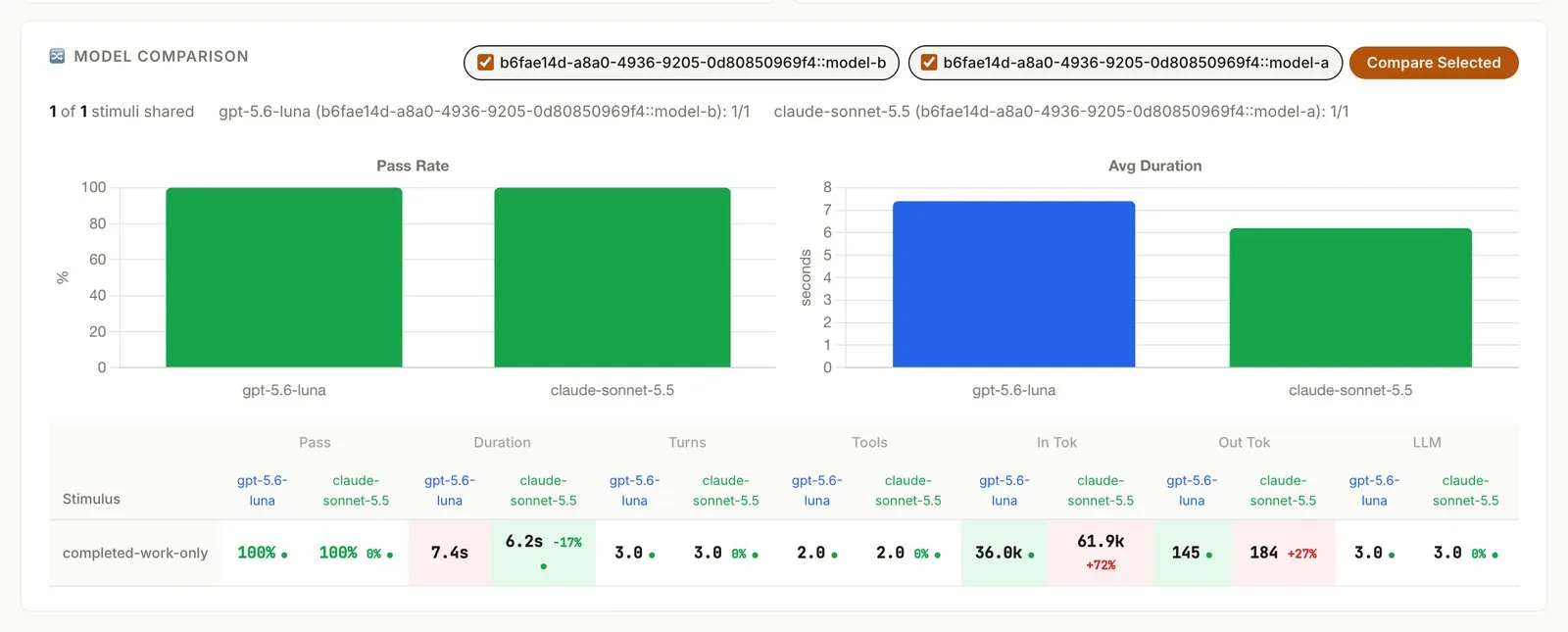
Same pass rate, same number of turns and tool calls, but different speed and very different token counts. The deltas are relative to the first column.
-
Read a few answers from each model with
./scripts/answers.sh. Both pass every check, but do they read the same? Style, length and tone can differ in ways your checks don’t cover; that’s where a judge from Lab 5 helps.
Two models can both pass every check and still differ in cost, speed and style. With three trials each, a one-trial difference in pass rate can be luck; for a real decision, use more trials and more tasks.
Part B: a model on your own endpoint as the agent
Section titled “Part B: a model on your own endpoint as the agent”If you have your own model endpoint, as described in Model access and costs, you can make one of its models the agent under test. Copilot’s harness still runs the agent, but every model call goes to your endpoint, so no Copilot request is used.
-
Copy the eval made for this, and read its
defaults:Terminal window cp lab-files/lab-8/release-notes-endpoint.eval.yaml evals/defaults:model: ${AGENT_MODEL=set-your-deployment-name} # the deployment name on your endpointruns: 3timeout: 180sexecutor:name: copilot-sdk # the same agent harness as before ...config:provider: # ... but its model calls go to your endpointtype: azurebaseUrl: ${AGENT_BASE_URL=https://set-your-endpoint.invalid/openai/v1/} # replaced by --paramwireApi: responsesapiKeyEnv: LLM_API_KEY -
Run it:
Terminal window vally eval -e evals/release-notes-endpoint.eval.yaml \--param AGENT_BASE_URL="$LLM_BASE_URL" \--param AGENT_MODEL="$LLM_MODEL"It needs
LLM_BASE_URL,LLM_API_KEYandLLM_MODELin your environment;./scripts/check-setup.sh --pingtests them. In our run with a GPT-5-family deployment, all three trials passed, with about 31,000 tokens each. -
Compare its
eval-results.mdwith part A’s results: pass rate, tokens, duration and tool calls. Then look at the tool calls with./scripts/answers.sh --tools: did the model on your endpoint use the skill the same way?
Check yourself
Section titled “Check yourself”Model B passes 3 of 3 and model A 2 of 3. Is model B better?
Not proven. With three trials each, one trial’s difference is easily chance. It’s a lead worth a bigger run: more trials, more tasks, and a look at the failing transcript.
Stuck?
Section titled “Stuck?”- A model isn’t available: pick another from
/model. - Part B fails with a 400 error: the deployment must support tool calls with the Responses API, such as a GPT-5-family model.
Next: Lab 9: Your own agent
Workshop created by Jeffrey Groneberg · Connect on LinkedIn
The illustrations are AI-generated (MAI-Image-2.6). Command output comes from real runs with Vally 0.21.0 in November 2026.