Trials and metrics
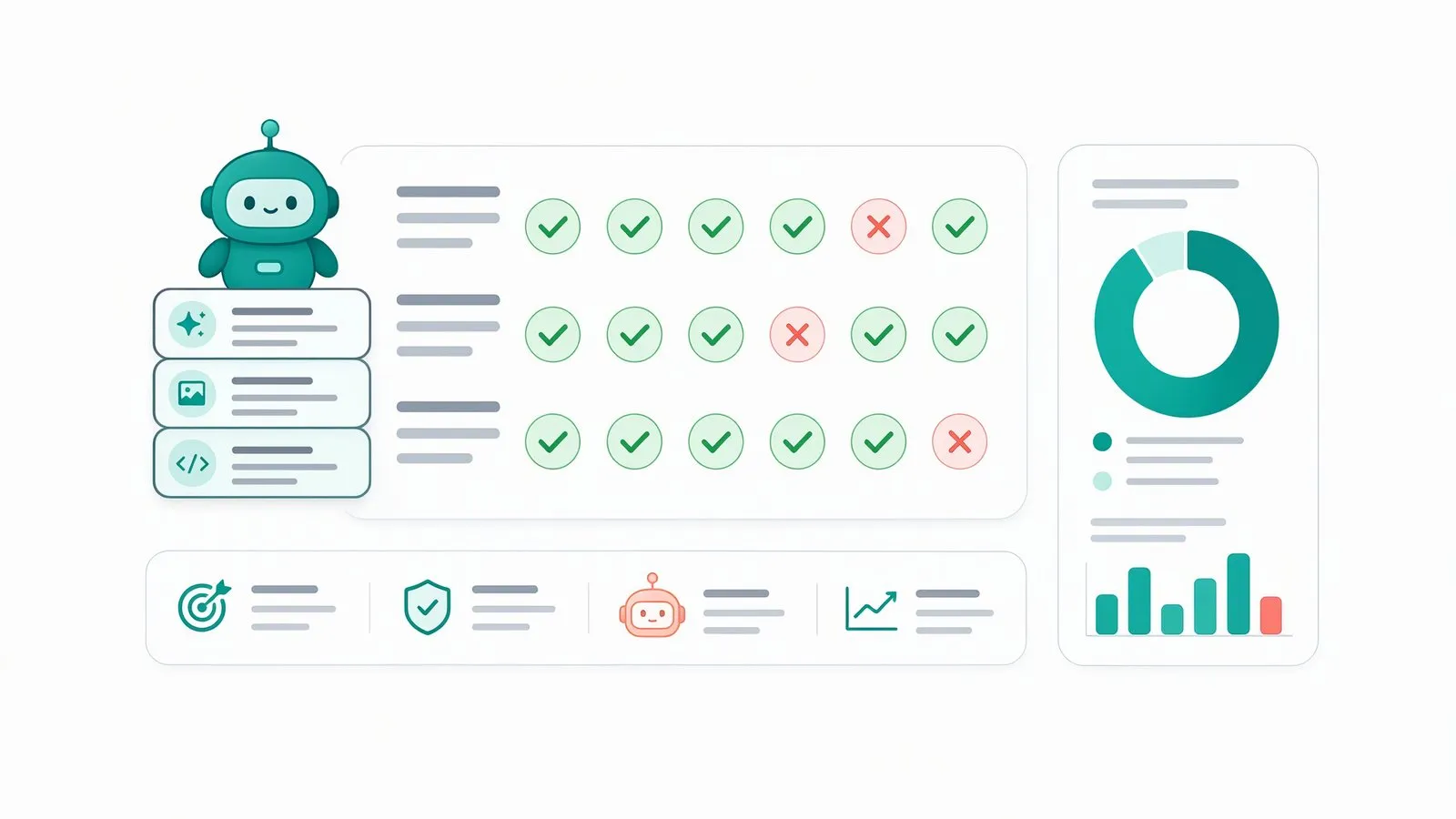
An agent can give a different answer every time you ask it the same thing. So a single run tells you only what can happen, not what usually happens. That’s why evals run each task several times. Each run is a trial.
- You
- Vally the eval runner
- Agent
- Checks
- You to Vally: Asks for several trials
runs: 3in the eval file, or--runs 5for one run. - For each trial, in parallel
- Vally to Agent: Sends the same task In a fresh workspace every time.
- Agent to Vally: Answers Not always the same way.
- Vally to Checks: Hands over the evidence
- Checks to Vally: Pass or fail One verdict per trial.
-
- Vally: Computes the metrics Pass rate: the share that passed. pass@k: did any pass? pass^k: the chance that all k pass.
- Vally to You: Reports them per task In
eval-results.mdand on the dashboard.
Why one run isn’t enough
Section titled “Why one run isn’t enough”In our test runs of the release-notes skill with its bug, the trials gave two different kinds of answer:
- In some, the agent listed CT-102 as a new feature, following the skill’s buggy rule.
- In others, the agent noticed CT-102 was unfinished, left it out of the list, but mentioned it in a note: “I left out CT-102 because it’s still in progress.”
The mix changed from run to run: in one run of three trials, two listed CT-102; in another, none did.
If you had run it once and got the second kind of answer, you might have thought the agent handled the bug well. But the note still announces CT-102, and the first kind of answer shows the bug does reach the list. Only several trials show the range of what the agent does.
Pass rate
Section titled “Pass rate”The pass rate is the fraction of trials that passed: 2 of 3 trials is a pass rate of 67%. It’s the first number to look at. Vally shows it per task in the Pass Rate column of eval-results.md.
pass@k and pass^k
Section titled “pass@k and pass^k”With two or more trials, Vally adds two metrics that answer two different questions. In both, k is the number of trials.
| Metric | Say it as | Question it answers | Vally’s formula |
|---|---|---|---|
| pass@k | “pass at k” | Can the agent do this at all, given k tries? | 1 if any trial passed, else 0 (with k = the number of trials) |
| pass^k | “pass hat k” | Can I rely on it every time, k times in a row? | pk, where p is the pass rate |
For three trials:
| Trials passed | Pass rate | pass@3 | pass^3 |
|---|---|---|---|
| 0 of 3 | 0% | 0% | 0% |
| 1 of 3 | 33% | 100% | 4% |
| 2 of 3 | 67% | 100% | 30% |
| 3 of 3 | 100% | 100% | 100% |
The gap between them is the point. An agent that passes 2 of 3 trials can do the task (pass@3 is 100%), but the chance that it gets three requests in a row right is only about 30%. Which metric you care about depends on the job:
- pass@k fits tasks where a person picks the best of several attempts, or where retrying is cheap.
- pass^k fits tasks where every single run must be right, such as an agent that publishes release notes without review.
How many trials?
Section titled “How many trials?”- For learning and quick checks: 3 trials, as in the labs.
- For decisions (shipping a change, choosing a model): more trials and more tasks. With 3 trials, a difference of one passing trial is easily luck.
- When results alternate between pass and fail across trials, Vally labels the task FLAKY. That’s information, not an error: the agent is unreliable on that task. Read the passing and the failing transcripts side by side.
Other numbers in a run
Section titled “Other numbers in a run”Vally’s results also show, per task:
- Duration: how long each trial took.
- Tokens: how much text the model read and wrote, which drives cost.
- Turns and Tool calls: how many steps the agent took. A fix that makes an agent pass but triples its tool calls might not be the fix you want.
Is anything deterministic?
Section titled “Is anything deterministic?”Yes: the code graders always give the same verdict for the same answer, and the mock executor always returns the same answer. What varies is the agent’s answer and, to a smaller degree, an LLM judge’s verdict. Pinning the model, as the labs do, makes runs comparable, but not identical. See Model access and costs.
Workshop created by Jeffrey Groneberg · Connect on LinkedIn
The illustrations are AI-generated (MAI-Image-2.6). Command output comes from real runs with Vally 0.21.0 in November 2026.