Graders
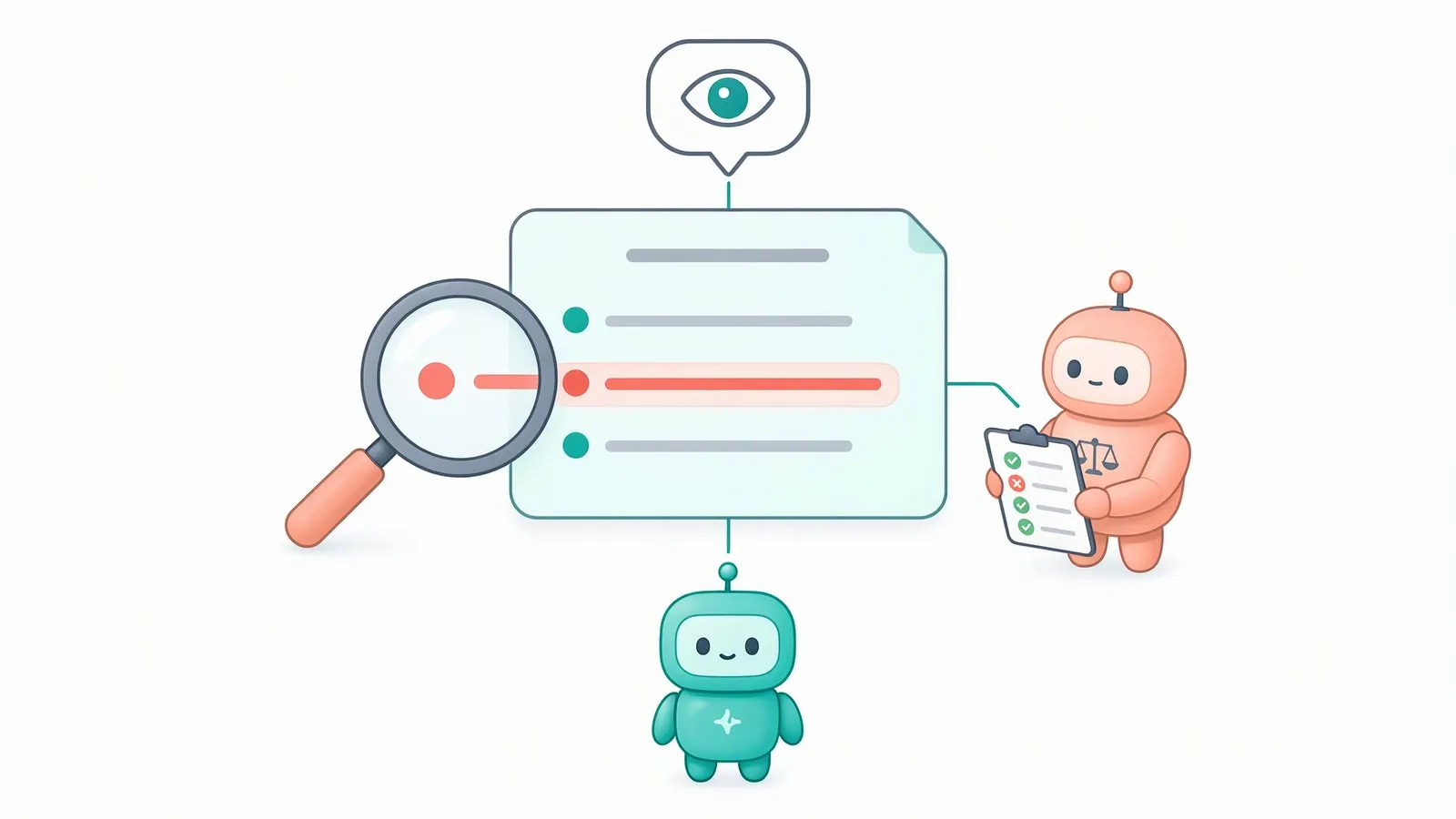
A grader decides whether a trial did what you wanted. It looks at the answer, the transcript or the workspace, and returns three things: pass or fail, a score from 0 to 1, and evidence, the reason for its decision. An eval is only as good as its graders: a grader that can’t tell a good answer from a bad one makes every score meaningless.
- Agent
- Vally the eval runner
- Code checks free, instant
- LLM judge a second model
- Agent to Vally: Finishes a trial Leaving three kinds of evidence: the answer, the transcript, the workspace.
- Vally to Code checks: Hands over the evidence Each check reads the part it needs.
- Code checks to Vally: Pass or fail, with evidence The same result every time, at no cost.
- Vally to LLM judge: Sends the trajectory and the rubric For qualities a string match can't see.
- LLM judge to Vally: Verdict and reasoning A model call: it takes seconds and costs tokens.
- Vally: Scores the trial All results against the threshold: pass or fail.
Three kinds of graders
Section titled “Three kinds of graders”| Code grader | LLM judge | Human review | |
|---|---|---|---|
| How it decides | Checks something exactly: text, a file, a tool call | A second model applies a written rubric | A person reads and decides |
| Good for | Facts: “CT-102 isn’t announced”, “the backlog wasn’t changed” | Qualities: tone, completeness, “a summary sentence comes first” | Calibrating the other two; unclear cases |
| Speed and cost | Instant, free | Seconds, costs tokens | Slow, costs people’s time |
| Same result every time? | Yes | Not always | Not always |
| Weak spot | Brittle: misses a good answer phrased differently, or a bad answer that avoids the exact text | Can be lenient, biased or inconsistent | Doesn’t scale |
| In Vally | output-contains, file-contains, skill-invocation, run-command, and more |
prompt (one judge), panel (several) |
Reading eval-results.md and transcripts |
Use code graders wherever you can, and an LLM judge for what code can’t check. Use people to check both, especially at the start. In the labs you’ll start with code graders and add a judge in Lab 5.
What to check
Section titled “What to check”An agent’s work leaves three kinds of evidence, and a good eval checks each where it matters:
- The answer: does it contain what it must, and leave out what it must not? (
output-contains) - The transcript: did the agent do something it should, such as using the skill? (
skill-invocation) - The workspace: did the agent change, create or leave alone the right files? (
file-contains)
Mostly, grade the outcome, not the path: an agent may reach a good answer in a way you didn’t expect, and that’s fine. Check the path only where the path itself matters, for example “the skill was used” or “no file was deleted”.
Positive and negative checks
Section titled “Positive and negative checks”A positive check passes when something is present: “the answer contains CT-101”. A negative check passes when something is absent: “the answer doesn’t contain CT-102”. In Vally, you turn a check into a negative one with negate: true:
- type: output-contains name: leaves-out-unfinished-export config: { substring: CT-102, negate: true } # passes when CT-102 is NOT in the answerBugs often show up as something that shouldn’t be there: an unfinished feature, a leaked secret, an edited file. An eval with only positive checks can’t see them. You’ll experience exactly that in Lab 2.
Check your checks
Section titled “Check your checks”Before you trust a grader’s score, prove that the grader works. Give it answers you already know are good or bad, and see whether it agrees:
- A known-good answer must pass. If it fails, your check is too strict or simply wrong.
- An acceptable alternative (different order, different wording) must pass too. If it fails, your check depends on formatting instead of meaning.
- A known-bad answer must fail. If it passes, your check is blind to the bug you care about.
These known answers are called controls, after the control samples in a lab experiment.
Why the mock executor
Section titled “Why the mock executor”To feed known answers to your graders, you don’t want a real agent: it would write its own answer, not yours. Vally’s mock executor calls no model at all. It simply returns the task’s prompt text as the agent’s answer. So you put your known answer into the prompt, and the graders grade exactly that text.
- Normal trial executor: copilot-sdk
- Prompt "Write the release notes …"
- Agent works Copilot reads files and writes an answer
- Graders Grade the agent's answer
- Control trial executor: mock
- Prompt Your known answer, word for word
- No model The prompt text becomes the answer
- Graders Grade your known answer
That has four advantages:
- It isolates the grader. When a control fails, the grader is wrong, because nothing else was involved. Later, when a real trial fails, you know the agent failed, not your check.
- It’s free and fast. No model, no tokens, no Copilot requests. A control run takes a few seconds, so you can change a check and rerun it as often as you like.
- It’s deterministic. The same controls give the same result every time.
- It calibrates LLM judges too. Mock answers plus a real judge show how the judge decides on answers you understand, before you let it grade real ones. You’ll do that in Lab 5.
What the mock executor does not tell you is anything about the agent. A control run proves your measuring instrument, nothing more. From Lab 3 on, the real agent runs with the copilot-sdk executor.
Best practice, not a workshop trick
Section titled “Best practice, not a workshop trick”Checking checks with known answers is standard practice:
- GitHub Copilot Evals publishes a no-model control eval for release notes and a GitHub Actions workflow that runs it on demand with
--require-pass. - Vally has a separate command,
vally oracle, that grades a stored reference solution for tasks that change files: “If a grader doesn’t pass on the correct answer, the grader is wrong.” - Anthropic recommends writing a reference solution for every task, so you know the task can be passed and the graders are configured correctly.
In a real project, keep your controls next to your evals:
- Run the known-good controls whenever you change an eval, and gate on them with
--require-pass, as the GitHub Copilot Evals example does. They must always pass. - Rerun the known-bad controls when you change a grader. They’re meant to fail, so look at them rather than gating on them.
- Turn real failures into new controls. When you find a bad answer in a transcript, add it as a known-bad control, so the check that should catch it stays honest.
- Keep the copies in sync. Controls test copies of your checks. When you change a check in the real eval, change its copy too. A mock run makes no tool calls, so controls can test checks on the answer, but not checks on the transcript such as
skill-invocation.
Changing a check changes the measurement
Section titled “Changing a check changes the measurement”If an eval fails and you loosen its check, the pass rate goes up, but the agent didn’t get any better. Change a grader only when the grader is wrong (your controls show you), and change the agent when the agent is wrong (the transcripts show you).
Workshop created by Jeffrey Groneberg · Connect on LinkedIn
The illustrations are AI-generated (MAI-Image-2.6). Command output comes from real runs with Vally 0.21.0 in November 2026.