Lab 4: Fix it and prove it
You know the cause: the skill’s first rule. Now you fix it, and then you prove that your fix, and nothing else, made the agent pass. That proof is a controlled experiment: the same eval runs twice, once with the original skill and once with yours, with every other setting identical.
- changed
- seen before, different here
- You do
- Fix the skill, then prove the fix with an experiment: the same eval, run with the old and the new skill.
- Under test
- Your fix: does the fixed skill, and nothing else, make the agent pass?
- Checked by
- The five code checks from Lab 3, unchanged, on both variants
- Task Write the release notes from
backlog.json - Agent GitHub Copilot, the same model in both variants
- Environment changed The skill:
beforevsafter - Trials 3 per variant, 6 in all
- Checks Answer, transcript and workspace, as in Lab 3
- LLM judge Not used here
- Results changed Experiment comparison,
report.md, dashboard
vally experiment run experiments/skill-fix.experiment.yaml - new
- first time in the workshop
- changed
- seen before, different here
- You
- Vally the eval runner
- Baseline: before the original skill
- Variant: after your fixed skill
- Report
report.md
- You to Vally: Starts the experiment new One eval, two variants that differ only in the skill.
- Vally to Baseline: before: Runs the eval with the original skill Three trials, each in a fresh workspace, as in Lab 3.
- Baseline: before to Vally: Verdicts, tokens, time The baseline: what the original skill does.
- Vally to Variant: after: Runs the same eval with your fix changed Same model, same checks, same three trials.
- Variant: after to Vally: Verdicts, tokens, time The variant: what your one change does.
- Vally to Report: Writes the comparison new Pass rates, tokens and time side by side, in
report.md.
The pieces you’ll work with
Section titled “The pieces you’ll work with”- Baseline new
-
The "before" you compare against: here, the original skill.
- Variant new
-
A version of the eval with one deliberate change: here, your fixed skill.
- Experiment file new
-
Declares the comparison: which eval, which variants, and what may differ between them.
-
varynew -
The settings allowed to differ between variants. If anything else differs, Vally refuses to run, so the result can only come from the declared change.
- Frozen copy new
-
A copy of the original skill, so both versions exist side by side for one experiment.
Why this matters
Section titled “Why this matters”“I changed the skill and now it passes” isn’t proof. The agent varies from run to run; the model behind it can change; you might have changed two things at once. A controlled experiment rules these out: same eval, same model, same settings, same number of trials, one declared difference.
-
Fix the skill. Open
.github/skills/release-notes/SKILL.mdand find its first rule:- List every backlog item as a feature of this release, one bullet per item, formatted as `- ID: title`.Replace that whole line with these two lines:
- Include only items whose `status` is `done`. Leave every other item out and do not mention it anywhere in the notes.- List each included item as one bullet formatted as `- ID: title`.Save the file. The other rules stay as they are.
-
Optional: rerun the eval from Lab 3 to see the effect right away:
Terminal window vally eval -e evals/release-notes.eval.yamlIn our runs, all three trials passed. But a rerun alone doesn’t prove the fix made the difference; the experiment does.
-
Read the experiment file:
experiments/skill-fix.experiment.yaml name: release-notes-skill-fixevals:- ../evals/release-notes.eval.yaml# The only setting allowed to differ between variants. Any other difference is an error,# so a result can't come from a change you didn't mean to make.vary: [/environment/skills]baseline: beforevariants:before:environment:skills: ["../skill-versions/before/release-notes"]after:environment:skills: ["../.github/skills/release-notes"]Both variants run the same eval.
beforeloads the frozen copy of the original skill,afterloads your fixed skill. Paths are relative to the experiment file. -
Check the plan without calling any model:
Terminal window vally experiment run experiments/skill-fix.experiment.yaml --dry-runExperiment: release-notes-skill-fixBaseline: beforePlans: 2── before (baseline) ──Eval: release-notes-completed-onlyFile: ../evals/release-notes.eval.yamlModel: claude-sonnet-5.5Config hash: 48df94cc2d6ebe75Eval hash: 4c5c9c7166d5db5d── after ──Eval: release-notes-completed-onlyFile: ../evals/release-notes.eval.yamlModel: claude-sonnet-5.5Config hash: e032d16ce416ef24Eval hash: 4c5c9c7166d5db5dThe eval hash is identical, so both variants run exactly the same eval. The config hash differs, because the skills differ. If you haven’t changed the eval file or the model, your hashes most likely match ours: they’re computed from the settings. What matters is same and different.
-
Run the experiment. It runs three trials per variant, six in all:
Terminal window vally experiment run experiments/skill-fix.experiment.yamlLoaded 2 stimuli from release-notes-completed-only · 5 workersrelease-notes-completed-onlybeforeFAIL completed-work-only 0/3✘ leaves-out-unfinished-export 0 passed · 3 failed · 'CT-102' found in output trials 1–3· score 80.0% < threshold 100.0% · trials 1–3────────────────────────────────────────────────────────Experiment release-notes-skill-fix varying /environment/skills · baseline before→ after beat baseline — 1/1 vs 0/1 stimuli.after used ±0% tokens, −8% trial time.eval before (baseline) after Δrelease-notes-completed-only ✘ 0/1 (score 80% < 100%) ✓ 1/1 (score 100% ≥ 100%) +1──────────────────────────── ──────────────────────── ───────────────────────── ───stimuli 0/1 1/1 +1tokens 186.9k 186.3k ±0%trial time 29.5s 27.1s −8%Run ID: 7c9e327c-d094-46fc-99ae-017940e17ef8Output: /workspaces/agent-evals-workshop-starter/vally-experiment-results/2026-11-19T11-11-29-203ZVally lists the failures per variant first: only
beforefailed. Then the comparison:afterpassed wherebeforefailed, with the same tokens and slightly less time. -
Read the details. An experiment saves its runs in its own folder,
vally-experiment-results/<date-and-time>/, with one subfolder per variant:before/andafter/, each with theresults.jsonland trial folders you know.In the Explorer, right-click
report.mdin the newest experiment folder and select Open Preview: it has one table per variant. In ours,beforepassed 0 of 3 trials with pass@k and pass^k at 0%, andafterpassed 3 of 3 with both at 100%.Read the answers per variant with the shortcut from Lab 3; it picks the newest run, here the experiment:
Terminal window ./scripts/answers.sh════ release-notes-completed-only › completed-work-only · variant after · trial 1 · claude-sonnet-5.5 · PASS (score 100%)…════ release-notes-completed-only › completed-work-only · variant before · trial 1 · claude-sonnet-5.5 · FAIL (score 80%)Do the
afteranswers still contain a summary sentence and both done items? A fix that passes the checks but breaks something the checks don’t look at is no fix. -
Compare the variants in the dashboard. It shows one results folder at a time, so point it at the experiment: in the dashboard’s terminal, press Ctrl+C, then run:
Terminal window EXP=$(ls -d vally-experiment-results/*/ | tail -1)vally serve "$EXP" --port 3200 --allowed-host "${CODESPACE_NAME}-3200.${GITHUB_CODESPACES_PORT_FORWARDING_DOMAIN}"Reload the page. The two variants appear as two runs, named after the experiment’s run ID with
::beforeand::after. Scroll down to Model comparison, tick both, and select Compare Selected: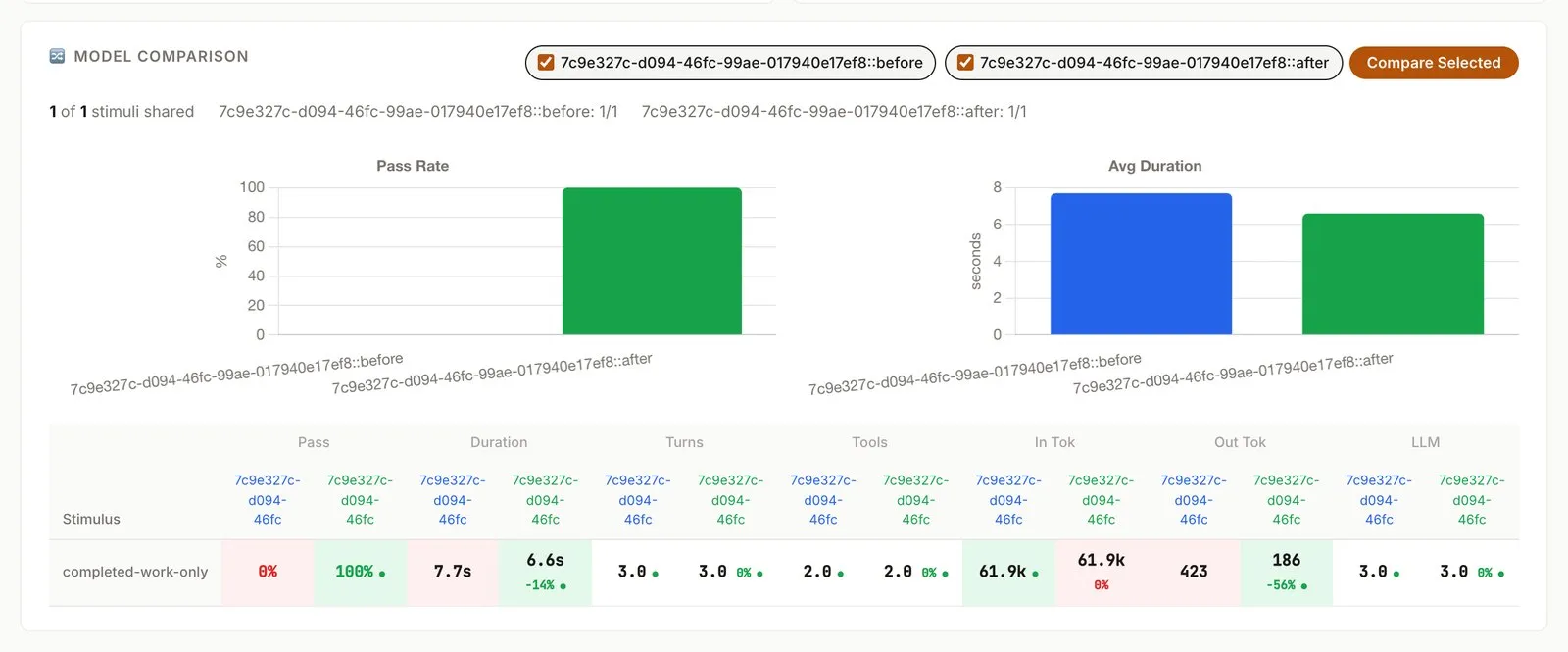
Blue is
before, green isafter: both column headers show the same shortened run ID. The pass rate went from 0% to 100%, while turns, tool calls and input tokens stayed the same: the agent did the same work, with a different result. In Lab 5, start the dashboard onvally-resultsagain, with the command from Lab 0.
What just happened
Section titled “What just happened”You proved the fix:
- Same eval, same model, same settings: the dry run showed identical eval hashes and the same model.
- One declared difference: the skill, the only path in
vary. - A clear result: 0 of 3 trials passed before, 3 of 3 after. Every check passed after the fix, including the CT-102 check.
- No hidden cost: tokens stayed the same, and trials got slightly faster.
The fixed skill’s answers look like this one:
This release makes it easier to find things and gives the dashboard a darker look.
- CT-101: Search across all projects- CT-103: Dark mode for the dashboard
Check yourself
Section titled “Check yourself”Why keep a frozen copy of the old skill instead of using Git history?
One experiment run needs both versions at the same time, at two different paths. Git history holds the old version, but not as a folder Vally can load next to the new one.
What would Vally do if the after variant also changed the model?
Refuse to run. The model isn’t in vary, so a different model would be an undeclared difference. Vally reports it as an error when it plans the experiment, so you can’t accidentally credit the skill for a model change.
0 of 3 before, 3 of 3 after. Is the fix proven for good?
It’s strong evidence for this task and this model, from six trials. It’s not proof for every request a user might type, and not for future models. That’s why you’ll keep running the eval on every change, in CI, in Lab 7.
Solution
Section titled “Solution”Compare your skill with ours. The highlighted lines are the two you write in step 1, in place of the rule that listed every backlog item.
The fixed skill
---name: release-notesdescription: Drafts release notes for the next release from the project backlog in backlog.json. Use when asked to write, draft or update release notes.---
# Release notes
Read `backlog.json` in the project root and draft the release notes for the next release.
- Include only items whose `status` is `done`. Leave every other item out and do not mention it anywhere in the notes.- List each included item as one bullet formatted as `- ID: title`.- Start with one short sentence that summarizes the release.- Keep the tone friendly and short. Do not edit any files.Stuck?
Section titled “Stuck?”- Behind?
scripts/catch-up.sh 4puts the fixed skill in place. - A trial shows
ERRORwithSession disconnected while waiting for a response, or another connection problem: the trial didn’t finish. It counts neither as a pass nor as a fail, and it skews the comparison of tokens and time, because that variant has fewer finished trials. Run the experiment again../scripts/answers.shshows such a trial asERROR, with the message. - A variant fails with an error that names a path or says
not found: a skill path is wrong. Paths in the experiment file are relative to theexperiments/folder. - Your
aftervariant still fails: check your edit againstsolutions/lab-4/SKILL.md, and read the failing answer withscripts/answers.sh.
Go further
Section titled “Go further”vally compare goes beyond pass rates: an LLM judge compares the before and after answers pair by pair and estimates which variant is better, with a confidence interval. Add --compare to the experiment command to run it right after the trials. It spends tokens on the LLM judge; you choose the judge’s model with --judge-model. See vally compare in the Vally docs.
Next: Lab 5: Add an LLM judge
Workshop created by Jeffrey Groneberg · Connect on LinkedIn
The illustrations are AI-generated (MAI-Image-2.6). Command output comes from real runs with Vally 0.21.0 in November 2026.