What is an eval?
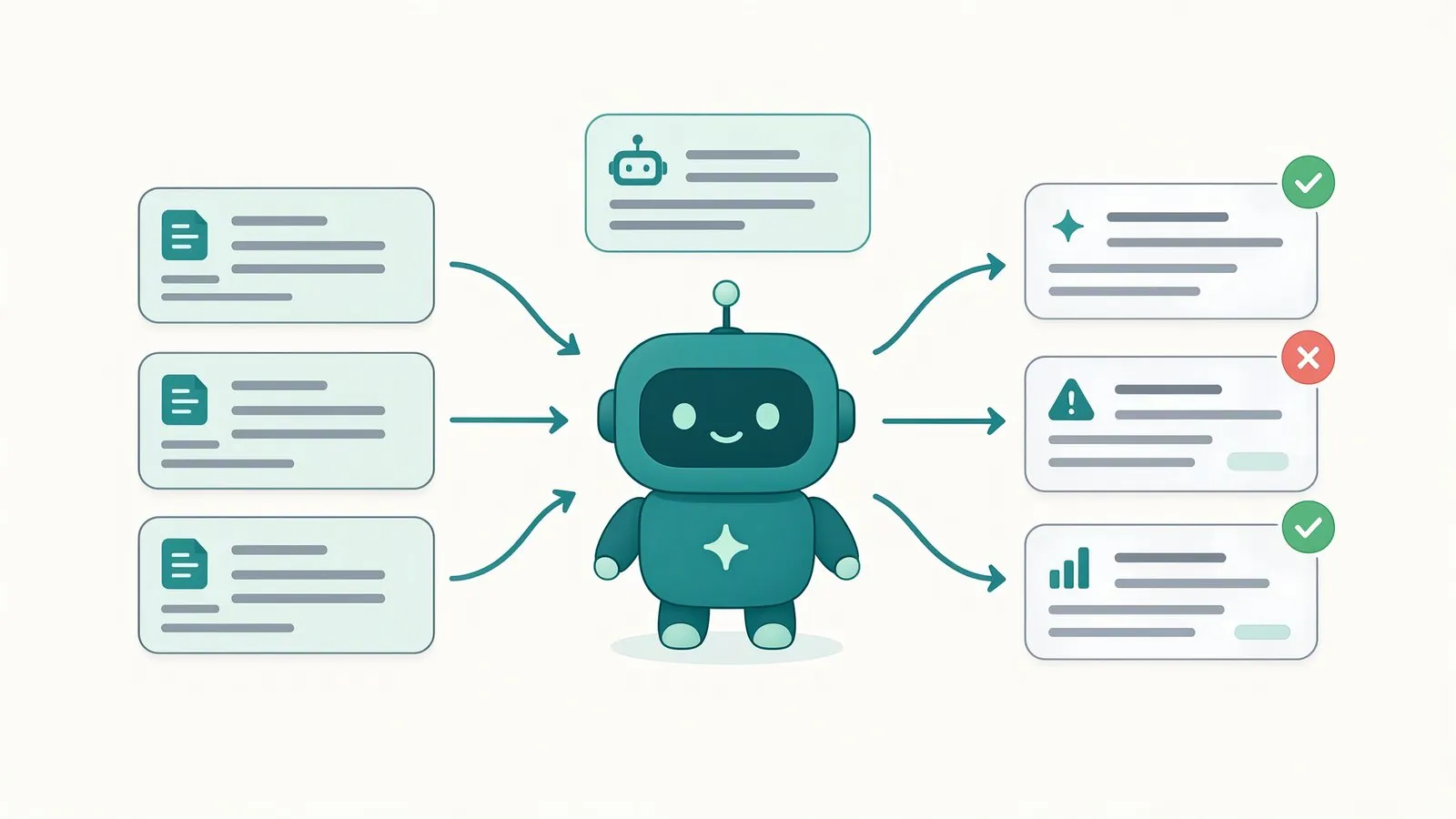
Evals turn “looks good” into a check you can repeat.
An eval (short for evaluation) is a repeatable test for output that can change. You give an AI agent a task in a known starting situation, let it work, and then check what it did and what it produced against criteria you wrote down beforehand. Because the agent’s output varies from run to run, you run the same task several times and report how often it succeeds.
- You
- Eval runner Vally, in the labs
- Agent model, instructions, tools
- Graders code checks or an LLM judge
- You to Eval runner: Starts the eval A task, a starting situation, and what good looks like.
- Several trials of the same task
- Eval runner to Agent: Gives it the task Each time in a fresh copy of the starting situation.
- Agent to Eval runner: Answers Possibly differently from the trial before.
- Eval runner to Graders: Hands over the evidence The answer, what the agent did and what it changed.
- Graders to Eval runner: Pass or fail With evidence for the verdict.
-
- Eval runner to You: Reports a pass rate Not one verdict, but how often the agent succeeds.
Why agents need evals
Section titled “Why agents need evals”Traditional code is deterministic: the same input gives the same output, so one passing test means something. An AI agent is different:
- It isn’t deterministic. The same prompt can produce different answers, different tool calls and different results. One good answer proves only that a good answer is possible.
- It has many moving parts. The model, its instructions (such as a skill), its tools, and the files it can see all shape what it does. Change any one of them, and its behavior can change somewhere you didn’t look.
- “Looks good to me” doesn’t scale. Trying a prompt by hand a few times catches obvious problems, not the one-in-five failure that reaches a customer.
- Models change. When a new model comes out, an eval tells you within minutes whether it’s better for your tasks, not on someone else’s benchmark.
Evals and unit tests
Section titled “Evals and unit tests”Evals borrow the idea of a test, but the details differ:
| Unit test | Eval | |
|---|---|---|
| What runs | Your code | An AI agent: a model with instructions and tools |
| Same input twice | Same output | Often a different output |
| How often you run it | Once | Several trials, then a pass rate |
| What you check | Exact values | The answer, what the agent did, and what it changed, sometimes with judgment |
| The result | Pass or fail | A pass rate, plus evidence for each trial |
| When it fails | Your code is wrong | The agent, its instructions, the task or the check may be wrong; you read the transcript to find out which |
So an eval isn’t “a unit test for AI”. It’s a test for output that can change.
What you can evaluate
Section titled “What you can evaluate”Anything that steers an agent’s behavior:
- Skills:
SKILL.mdinstructions an agent loads for a kind of task. That’s what you’ll evaluate in the labs. - Agent instructions and prompts: custom instructions, system prompts and prompt files.
- Tools: for example, MCP servers. Does the agent pick the right tool, with the right arguments?
- Models: the same tasks on two models, to choose between them.
- Whole agents: an agent with all of its instructions and tools.
The eval loop
Section titled “The eval loop”Evals aren’t a one-off. You’ll follow this loop through the labs:
- Define good Write the criteria before any run
- Check the checks Known answers, no model
- Run trials Several runs of each task
- Read transcripts Find out why it failed
- Change one thing Then compare with the baseline
- Guard it Run the eval on every change
- Define good before you run anything. If two people can’t agree whether an answer passes, the task or the criteria are unclear. (Lab 1)
- Check the checks with answers you already know are good or bad. (Lab 2)
- Run trials and look at the pass rate, not one run. (Lab 3)
- Read the transcripts. A pass rate tells you that something fails; the transcript tells you why.
- Change one thing and compare it with the baseline, so you know what made the difference. (Lab 4)
- Guard it: once the agent passes, run the eval on every change, so it keeps passing. (Lab 7)
Capability evals and regression evals
Section titled “Capability evals and regression evals”Evals serve two purposes, and the same eval can move from one to the other:
- A capability eval asks “can the agent do this yet?” It may start with a low pass rate, and you work to raise it. The release-notes eval starts here: the skill has a bug, so it fails.
- A regression eval asks “does the agent still do what it used to?” It should pass close to 100% of the time, and a drop means something broke. Once you’ve fixed the skill, the release-notes eval becomes this kind: you run it on every pull request.
Workshop created by Jeffrey Groneberg · Connect on LinkedIn
The illustrations are AI-generated (MAI-Image-2.6). Command output comes from real runs with Vally 0.21.0 in November 2026.