Anatomy of an eval
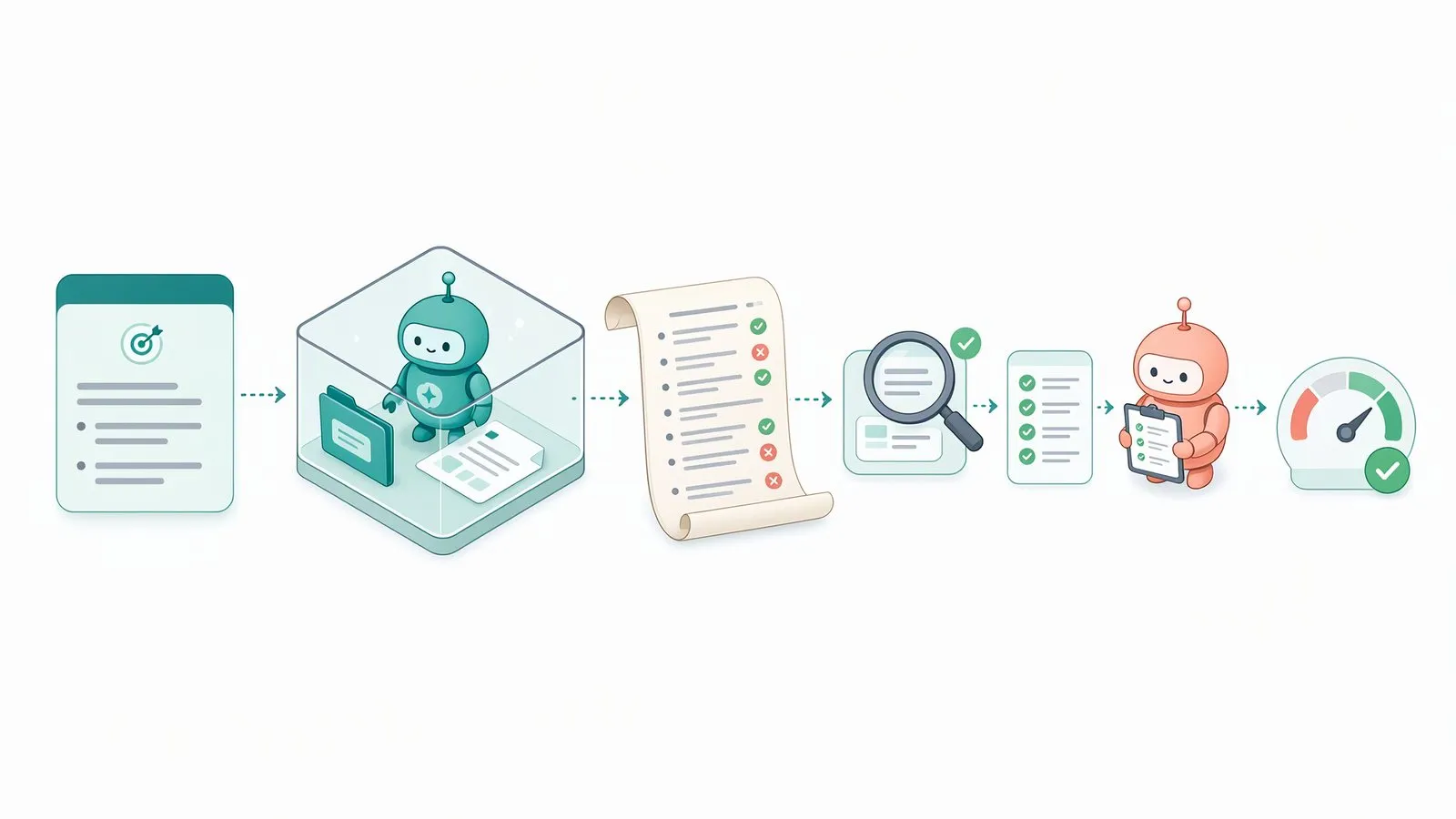
Every eval, whatever tool runs it, has the same parts. Learn them once, and Vally’s YAML, the GitHub Copilot Evals screens and other eval tools all start to read the same. This page is the reference the labs point back to.
One trial, step by step
Section titled “One trial, step by step”A trial is one run of one task. Here’s what happens in every trial:
- Vally the eval runner
- Agent under test started by the executor
- Graders checks and judges
- Trial record
results.jsonl
- Vally: Takes one task In Vally, a stimulus: the prompt and its inputs.
- Vally: Prepares the environment A fresh workspace with the skills and files the task needs.
- Vally to Agent under test: The executor starts the agent And sends the prompt.
copilot-sdkruns GitHub Copilot. - Agent under test: Works Turns, tool calls, skill use: the transcript records each one.
- Agent under test to Vally: Finishes With an answer, and a workspace it may have changed.
- Vally to Graders: Hands over the evidence Each grader reads the answer, the transcript or the workspace.
- Graders to Vally: Pass or fail, a score, evidence One result per grader.
- Vally to Trial record: Records the verdict The score against the threshold: the trial passes or fails.
Then the same task runs again, several times, and the eval reports the pass rate: how many trials passed.
The parts
Section titled “The parts”What you give the agent
Section titled “What you give the agent”- Eval (eval spec)
-
One file that describes a complete test: the tasks, the environment, the checks and the settings.
- Task (stimulus)
-
One request to the agent: the prompt, plus everything specific to that request. Vally calls it a stimulus; other tools say task or test case.
- Environment
-
What the agent finds when it starts: skills, files, settings. Vally builds a fresh, isolated workspace for every trial, so one trial can't affect the next, and nothing else from your repository reaches the agent.
- Agent under test
-
The AI agent whose behavior you measure: a model, plus its instructions and tools. In the labs: GitHub Copilot with the release-notes skill.
- Executor (harness)
-
The part of Vally that starts and drives the agent.
copilot-sdkruns GitHub Copilot.mockruns no model at all: it returns the prompt as the answer, to test the checks.
What comes out of a trial
Section titled “What comes out of a trial”- Trial
-
One run of one task. Agents vary, so you run several trials of each task.
- Transcript (trajectory)
-
The full record of a trial: messages, tool calls and their results, tokens and timing. It tells you how the agent got its answer.
- Outcome
-
What the trial produced: the final answer, plus the state of the workspace afterwards (for example, whether a file changed).
How it’s judged
Section titled “How it’s judged”- Grader (check)
-
One test of the outcome or the transcript. It returns pass or fail, a score from 0 to 1, and evidence: why it decided that. Vally says grader; the GitHub Copilot Evals screens say check.
- Code grader
-
A grader that checks something exactly, without a model: does the answer contain a text, does a file contain a value, was a skill used. Fast, free and the same every time.
- LLM judge
-
A grader that asks a second model to read the answer and decide against written criteria. For qualities code can't check, such as tone. Slower, costs tokens, and needs checking itself.
- Rubric
-
The written criteria an LLM judge applies, one per line. It's the specification for the judge: vague criteria give inconsistent judgments.
- Score and threshold
-
A trial's score is the average of its graders' scores. The threshold is the score a trial needs to pass. With
threshold: 1, every check must pass. - Pass rate
-
How many trials passed, such as 2 of 3. With several trials, Vally also reports pass@k and pass^k.
How you organize and compare
Section titled “How you organize and compare”- Suite
-
A named group of evals you run together, for example everything tagged for CI.
- Baseline and variant
-
To compare a change, you run the same eval twice: the baseline (before) and a variant (after), with exactly one thing different.
The parts in a real file
Section titled “The parts in a real file”This is the eval you’ll run in Lab 3, with each part marked:
name: release-notes-completed-only # the evaldescription: The release-notes skill announces completed work only and leaves the in-progress status in backlog.json alone.type: capability # intent: "can the agent do this yet?"defaults: executor: copilot-sdk # executor: runs GitHub Copilot model: claude-sonnet-5.5 # the agent's model runs: 3 # trials per task timeout: 120sagent_environment: # environment, rebuilt for every trial skills: - ../.github/skills/release-notes # the skill under test files: - src: ../backlog.json dest: backlog.jsonscoring: threshold: 1 # every check must passstimuli: - name: completed-work-only # the task (stimulus) prompt: Write the release notes for this release from backlog.json. graders: # the checks - type: output-contains # code grader on the answer name: leaves-out-unfinished-export config: { substring: CT-102, negate: true } - type: output-contains name: includes-done-search config: { substring: CT-101 } - type: output-contains name: includes-done-dark-mode config: { substring: CT-103 } - type: skill-invocation # code grader on the transcript name: release-notes-skill-used config: required: - release-notes - type: file-contains # code grader on the workspace name: backlog-still-in-progress config: path: backlog.json value: '"status": "in-progress"'Notice the three things the graders look at: the answer (output-contains), the transcript (skill-invocation: did the agent use the skill?), and the workspace (file-contains). A complete eval checks all three where it matters.
The same parts in other tools
Section titled “The same parts in other tools”| This workshop | Vally YAML | GitHub Copilot Evals screens | Other tools often say |
|---|---|---|---|
| Task | stimuli |
Task, case | Test case, sample |
| Grader | graders |
Check | Evaluator, metric, scorer |
| Transcript | Trajectory | Transcript, evidence | Trace, log |
| Trial | Run (runs) |
Attempt | Epoch, repetition |
Workshop created by Jeffrey Groneberg · Connect on LinkedIn
The illustrations are AI-generated (MAI-Image-2.6). Command output comes from real runs with Vally 0.21.0 in November 2026.