Comparing changes
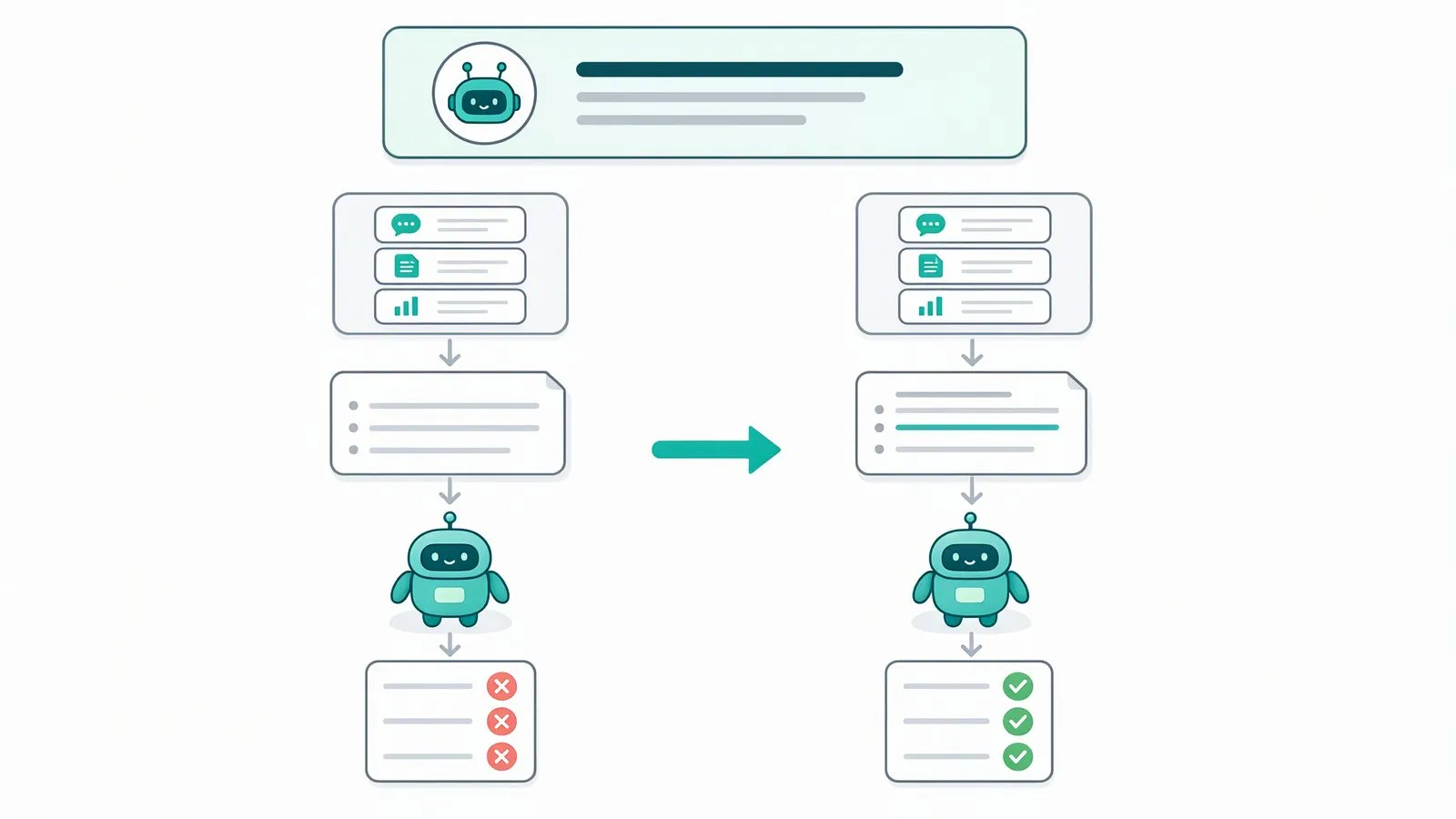
You changed a skill, and the eval passes now. Was it your change, or luck, or something else that changed at the same time, like the model? To know, you compare a baseline with a variant that differs in exactly one thing.
Baseline and variant
Section titled “Baseline and variant”- The baseline is the “before”: the version you compare against.
- A variant is an “after”: the same eval with one deliberate change, such as a fixed skill, another model or a reworded prompt.
- Everything else stays identical: the tasks, the graders, the model, the settings and the number of trials.
- You
- Vally the eval runner
- Baseline the "before"
- Variant one deliberate change
- Report
- You to Vally: Starts the experiment One eval, a baseline and a variant.
- Vally to Baseline: Runs the eval Several trials of the original setup.
- Baseline to Vally: Verdicts, tokens, time
- Vally to Variant: Runs the same eval Everything identical except the one change.
- Variant to Vally: Verdicts, tokens, time
- Vally to Report: Compares them Pass rates side by side, with the difference.
Experiments in Vally
Section titled “Experiments in Vally”A Vally experiment file declares the comparison. This is the one you’ll run in Lab 4:
name: release-notes-skill-fixevals: - ../evals/release-notes.eval.yaml # the eval to run for every variantvary: [/environment/skills] # the ONLY setting allowed to differbaseline: before # which variant is the "before"variants: before: environment: skills: ["../skill-versions/before/release-notes"] # the original skill after: environment: skills: ["../.github/skills/release-notes"] # your fixed skillvarylists what may differ between variants, as a path into the eval’s settings. Here it’s the skills. If anything else differs between the variants, Vally refuses to run: a result can’t come from a change you didn’t declare.variantssays what each variant changes. Each one can override the environment (skills, files) and settings such asmodel,executororruns.baselinenames the variant the others are compared with.
Run it with vally experiment run <file>. To see the plan without calling any model, add --dry-run. Both variants run in the same experiment, side by side, so a model update or a slow service affects both alike.
Reading the report
Section titled “Reading the report”The experiment ends with a summary like this one, from our test run:
Experiment  release-notes-skill-fix   varying /environment/skills · baseline before
  → after beat baseline — 1/1 vs 0/1 stimuli.    after used ±0% tokens, −7% trial time.
eval before (baseline) after Δ release-notes-completed-only ✘ 0/1 (score 80% < 100%) ✓ 1/1 (score 100% ≥ 100%) +1 stimuli 0/1 1/1 +1 tokens 186.8k 186.3k ±0% trial time 27.4s 25.4s −7%- Stimuli 0/1 → 1/1: the one task failed with the baseline and passes with the variant.
- Score 80% → 100%: before, four of the five checks passed in each trial; after, all five.
- Tokens and trial time: the cost side. A fix that doubles the tokens may not be worth it.
report.mdin the output folder has the details per variant, including the pass rate per check and pass@k and pass^k.
Comparing with a judge: vally compare
Section titled “Comparing with a judge: vally compare”Pass rates compare verdicts. Sometimes you want to know which answers are better, even when both pass. vally compare asks an LLM judge to compare the baseline’s and the variant’s answers pair by pair, and reports the difference with a 95% confidence interval. With --fail-on-regression, it exits with an error when the variant is clearly worse, which makes it useful in CI. It spends tokens on the judge, so you’ll find it under Go further in Lab 4.
Comparing in GitHub Copilot Evals
Section titled “Comparing in GitHub Copilot Evals”GitHub Copilot Evals compares saved runs without calling any model, and sorts the differences into fixed, persistent and new failures. In VS Code it’s Compare saved runs (no AI calls). You’ll try comparing with Copilot in Lab 6.
Workshop created by Jeffrey Groneberg · Connect on LinkedIn
The illustrations are AI-generated (MAI-Image-2.6). Command output comes from real runs with Vally 0.21.0 in November 2026.