Check your answer
Compare what MAI heard with your saved translation and show a match or a retry. This runs in JavaScript; no model call. You write the comparison.
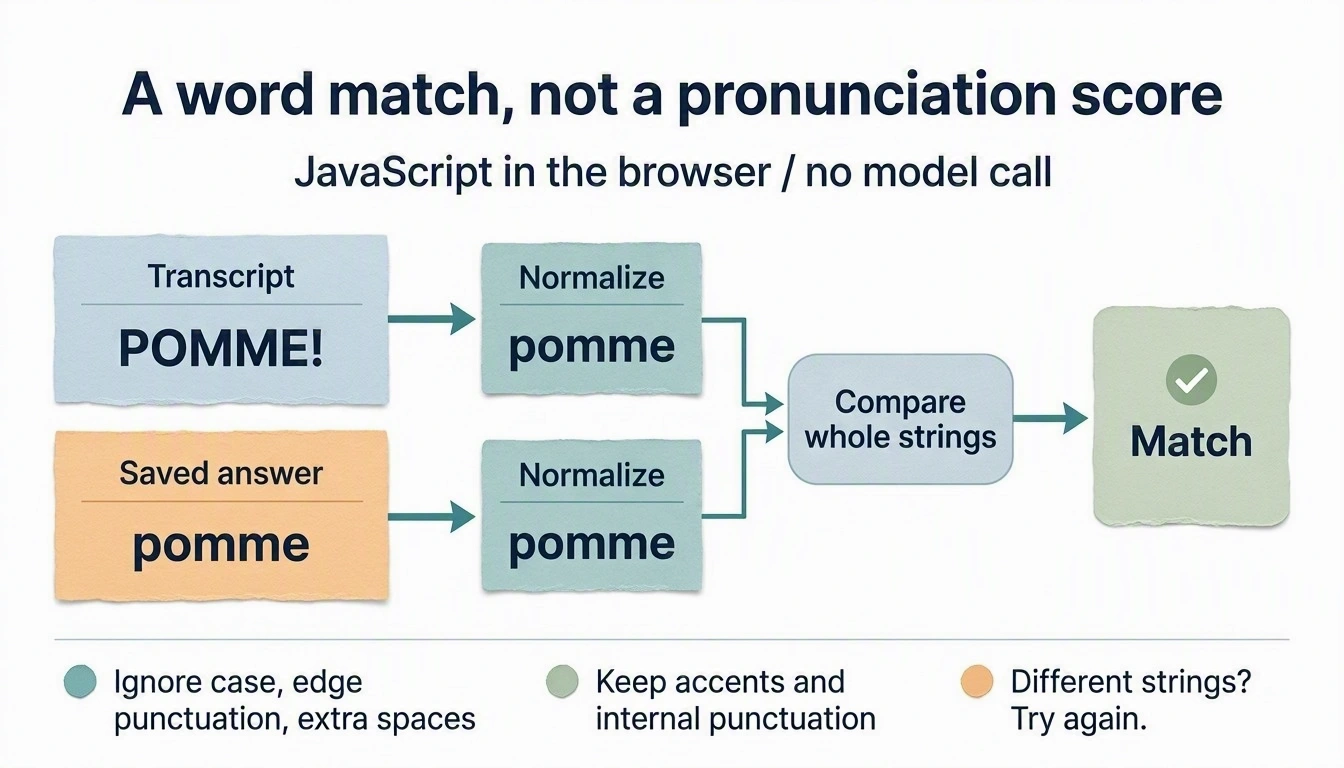
MAI-generated diagram. Full size.
Your turn: normalize and compare
What you'll build.
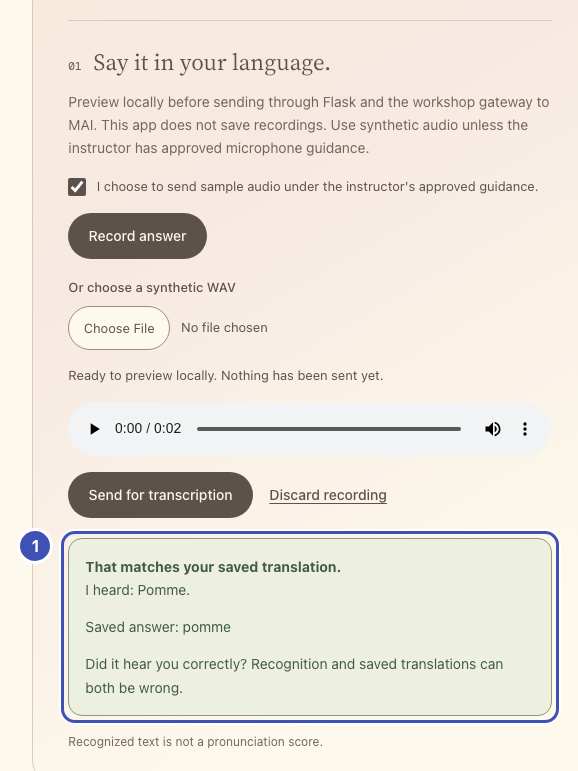
- ❶ Answer card: your
normalizeAnswercomparison decides between a match and a retry.
The same numbers mark the highlighted lines in the code below. Keep or delete
those ❶ comments; they only link code to the picture.
Why normalize instead of comparing strings?
The model writes Pomme. with a capital and a full stop; a saved pomme
should still match. Accents and inner punctuation stay because they change the
word. Matching needs no model, so it is instant, free, and deterministic.
Lesson 3 showed I heard: Pomme. for the saved answer pomme. A fair check
ignores case, punctuation around the answer, and extra spaces, but keeps
accents and punctuation inside it. It compares whole strings, not substrings.
In starter/static/app.js, replace everything from
// Lesson 4: replace from this line to // Lesson 4: replace to this line.,
including both marker lines, with your version of these two functions.
| Call | Should return |
|---|---|
normalizeAnswer(" POMME! ", "fr-FR") |
"pomme" |
normalizeAnswer("Été.", "fr-FR") |
"été" |
normalizeAnswer("une pomme", "fr-FR") |
"une pomme" |
normalizeAnswer("l'été", "fr-FR") |
"l'été" |
normalizeAnswer("İ", "tr-TR") |
"i" |
function normalizeAnswer(text, locale) {
  // TODO: NFC-normalize, lowercase for `locale`, remove punctuation and
  // whitespace at both ends, and collapse inner whitespace to one space.
  return text;
}

function showTranscript(heard, word) {
  const actual = normalizeAnswer(heard, word.locale);
  const expected = normalizeAnswer(word.target, word.locale);
  if (!actual) throw new Error("The transcript contains no usable words. Try another sample.");
  if (!expected) throw new Error("Your saved translation needs words, not only punctuation.");
  const matches = false; // TODO: compare the two normalized strings.
  const result = $("#answer-result");
  result.className = `answer-result ${matches ? "matched" : "try-again"}`;
  result.removeAttribute("lang");
  const heading = document.createElement("strong");
  heading.textContent = matches ? "That matches your saved translation." : "Not a match this time.";
  const transcript = document.createElement("p");
  transcript.textContent = `I heard: ${heard}`;
  transcript.lang = word.locale;
  const saved = document.createElement("p");
  saved.textContent = `Saved answer: ${word.target}`;
  saved.lang = word.locale;
  const caveat = document.createElement("p");
  caveat.textContent = "Did it hear you correctly? Recognition and saved translations can both be wrong.";
  result.replaceChildren(heading, transcript, saved, caveat);
  result.hidden = false;
}
Hint: the building blocks
text.normalize("NFC")makesétyped as one character equaleplus a combining accent.toLocaleLowerCase(locale)lowercases by the word's language; Turkishİbecomesi. Normalize again afterwards./^[\p{P}\s]+|[\p{P}\s]+$/gumatches Unicode punctuation and spaces at either end;/\s+/gufinds runs of inner whitespace.
Reference solution
function normalizeAnswer(text, locale) {
  return text.normalize("NFC").toLocaleLowerCase(locale).normalize("NFC").trim()
    .replace(/^[\p{P}\s]+|[\p{P}\s]+$/gu, "").replace(/\s+/gu, " ");
}

function showTranscript(heard, word) {
  const actual = normalizeAnswer(heard, word.locale);
  const expected = normalizeAnswer(word.target, word.locale);
  if (!actual) throw new Error("The transcript contains no usable words. Try another sample.");
  if (!expected) throw new Error("Your saved translation needs words, not only punctuation.");
  // ❶
  const matches = actual === expected;
  const result = $("#answer-result");
  result.className = `answer-result ${matches ? "matched" : "try-again"}`;
  result.removeAttribute("lang");
  const heading = document.createElement("strong");
  // ❶
  heading.textContent = matches ? "That matches your saved translation." : "Not a match this time.";
  const transcript = document.createElement("p");
  transcript.textContent = `I heard: ${heard}`;
  transcript.lang = word.locale;
  const saved = document.createElement("p");
  saved.textContent = `Saved answer: ${word.target}`;
  saved.lang = word.locale;
  const caveat = document.createElement("p");
  caveat.textContent = "Did it hear you correctly? Recognition and saved translations can both be wrong.";
  result.replaceChildren(heading, transcript, saved, caveat);
  result.hidden = false;
}
Check: save, reload, and try the calls from the table in the browser's
DevTools console; functions in app.js are global.
Run: send the lesson 3 sample again. The card says That matches your saved translation. Then send a different word's WAV against the same entry and confirm Not a match this time. This checks the recognized word, not pronunciation quality.
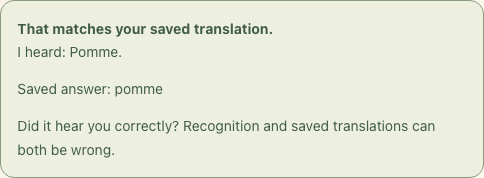
Captured with a recorded example transcript.
Catch up: python checkpoints/restore.py 04 copies this lesson's finished
files over yours, after backing yours up.
Try one
- Compare strictly. Replace
const matches = actual === expected;withconst matches = heard === word.target;, reload, and resend:Pomme.no longer matchespomme. Restore normalization. - Accents count. Save
summer/étéandsummer/etein French, download theétéWAV, and send it to both: only the accented entry matches. First check that the preview plays for under a second. About one in five one-word downloads contains extra speech (we got a 1.9-second take that saidun été. Été., which matches neither entry); download it again if so.