MCP + Deep Agents
This is the smallest useful version of the integration implemented by this repository: start WorkIQ as a local MCP server, adapt its discovered tools for LangChain, apply policy, and give the approved tools to a Deep Agent.
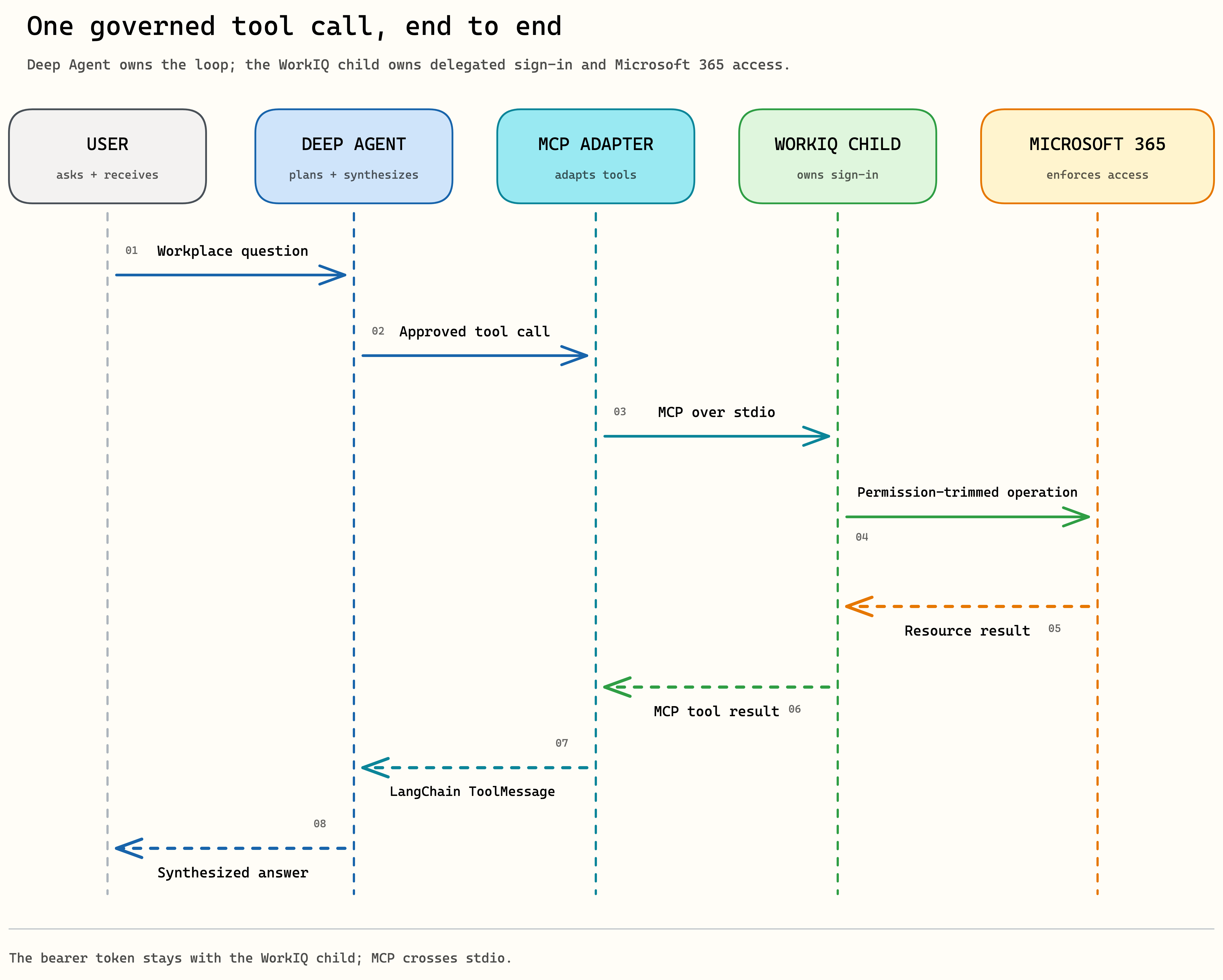
The Python process never receives the WorkIQ bearer token. The @microsoft/workiq child owns its
interactive sign-in and communicates with Python through MCP messages over stdio.
Run the example
Prerequisites are Python 3.11+, Node.js with npx, uv, Azure CLI, and a WorkIQ-enabled Microsoft
365 tenant. The repository setup
accepts the WorkIQ EULA and configures WORKIQ_AGENT_MODEL_BASE_URL and
WORKIQ_AGENT_MODEL_TENANT_ID. Review the delegated authentication boundary,
then run the included read-only example:
Core integration
async def ask_workiq(question: str) -> str:
    settings = Settings()
    client = MultiServerMCPClient({"workiq": settings.workiq_connection()})

    async with client.session("workiq") as session:
        discovered_tools = await load_mcp_tools(session, server_name="workiq")
        tools = select_workiq_tools(discovered_tools, allow_writes=False)

        agent = create_deep_agent(
            model=create_model(settings),
            tools=tools,
            system_prompt=READ_ONLY_PROMPT,
            checkpointer=InMemorySaver(),
            name="workiq_example",
        )
        state = await agent.ainvoke(
            {"messages": [{"role": "user", "content": question}]},
            config={"configurable": {"thread_id": str(uuid4())}},
        )

    return response_text(state)
The MCP session encloses agent.ainvoke. Closing it earlier would leave the Deep Agent with tool
descriptors whose underlying stdio transport is gone.
What each boundary owns
| Boundary | Responsibility |
|---|---|
Settings.workiq_connection() |
Describes npx -y @microsoft/workiq mcp as an MCP stdio server. |
load_mcp_tools() |
Converts discovered MCP tools into LangChain tools. |
select_workiq_tools() |
Removes mutation and blob tools before the model sees them. |
create_model() |
Creates the caller-owned Azure Responses model. |
create_deep_agent() |
Runs the model/tool loop and checkpoints thread state. |
response_text() |
Extracts display text from the final agent state. |
Production delta
The full CLI adds streamed model and tool lifecycle events, usage and cost metrics, chat thread
reuse, prerequisite diagnostics, and explicit write enablement. For durable deployment, replace
InMemorySaver with a persistent checkpointer and key every thread by tenant and user.
Keep write tools disabled by default. Enabling them requires both WorkIQ tenant/path policy and an
application-controlled approval step immediately before mutation. --allow-writes exposes the
discovered write tools and changes the system prompt; it does not implement that trusted approval
gate. A production host must interrupt tool execution, display the exact operation and arguments,
and require fresh user confirmation before sending the call.
Sources: Deep Agents customization, LangChain MCP adapters, and the Work IQ MCP overview.