Authentication and delegated access
All three surfaces operate as a signed-in user and use the same published WorkIQ resource and delegated scope. Protocol choice changes token acquisition and presentation, not the Microsoft 365 authorization boundary.
The resource is the token audience; the scope is the delegated permission. Check them separately
when diagnosing authorization failures. WorkIQAgent.Ask requires admin consent and has no
published application-permission equivalent. Consent permits the WorkIQ call, but user ACLs and
tenant, path, method, and workload policy still decide what that call may do.
Effective access
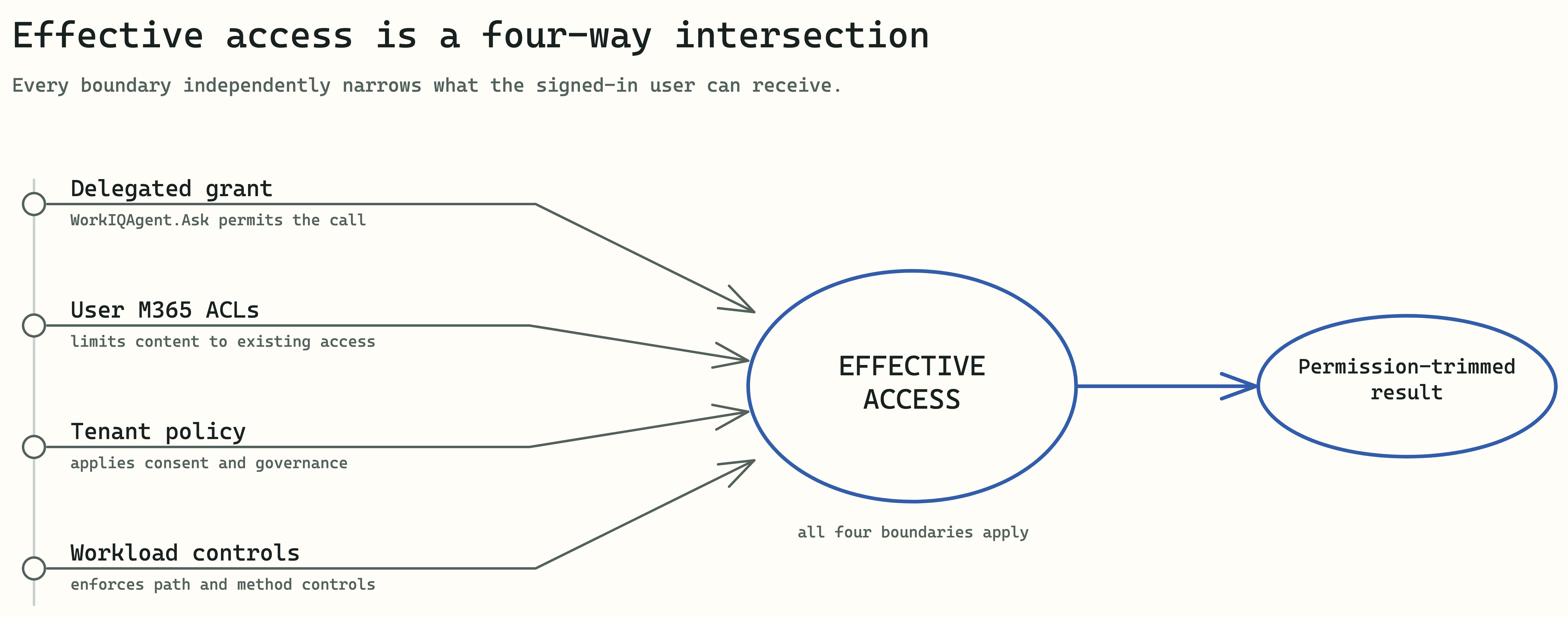
A delegated grant cannot elevate the user beyond their Microsoft 365 access. Licensing, sensitivity labels, information barriers, and workload policy still apply.
Client patterns
| Topology | Flow | Token presenter |
|---|---|---|
| MCP over local stdio | WorkIQ CLI interactive auth | WorkIQ child process |
| Remote MCP | OAuth discovery + PKCE or OBO | MCP client |
| Local A2A or REST | Public client + authorization code with PKCE | Caller |
| Hosted A2A or REST | Confidential backend + OBO | Backend |
Proof Key for Code Exchange (PKCE) protects the authorization-code flow for clients that cannot hold a secret. OAuth On-Behalf-Of (OBO) lets a hosted backend exchange the signed-in user's token for a delegated WorkIQ token without changing the represented user.
Public client
Use authorization code with PKCE through the system browser or broker. A CLI is a public client and must not contain a client secret. Cache tokens through the identity library and key state by tenant and user.
Hosted backend
Use OBO to exchange a user token issued for the backend API for a delegated WorkIQ token. The backend authenticates with a certificate, federated credential, or secret; the downstream token still represents the user.
Local MCP
This project starts npx -y @microsoft/workiq mcp over stdio. The child owns sign-in, token caching,
refresh, and reauthentication. Python controls which discovered tools reach the model but does not
handle the WorkIQ bearer token.
For remote MCP, discover authorization from the protected-resource and authorization-server metadata instead of hard-coding an OAuth server or assuming consent authorizes every path or method.
Security invariants
- Scope conversation, context, and task IDs by tenant, user, and their owning chat, thread, or workflow.
- Treat IDs as routing state, never authorization.
- Keep tokens, tool payloads, grounded text, and unrestricted reference URLs out of logs.
- Require a fresh authorized call whenever state is reused.
- Gate MCP mutations with both tenant policy and local user confirmation.
Fast diagnosis
| Symptom | Check first |
|---|---|
401 |
Audience, issuer, expiry, tenant, and client ID |
| Consent failure | Admin consent for the exact registration and scope |
403 |
Scope, user ACL, tenant policy, license, and workload restrictions |
| Empty result | User access to the source in Microsoft 365 |
| MCP read succeeds, mutation fails | Path/method policy and local allowlist |
| Stored ID fails | Current authorization, identity ownership, then retention |