Control and state
MCP, A2A, and REST expose different integration contracts with overlapping ability to answer natural-language questions. Query complexity does not distinguish them.
Architecture matrix
| Concern | MCP | A2A | REST |
|---|---|---|---|
| Public abstraction | Tool | Task | Conversation turn |
| Recommended caller | LLM-based client | Another agent | Application or backend |
| Natural-language answer | ask response |
Task artifact | Chat response |
| Orchestration owner | MCP host; WorkIQ inside ask |
WorkIQ agent | WorkIQ |
| Granular entity operations | Yes | No public primitive | No |
| Caller-controlled writes | Yes, policy gated | Agent-dependent | No |
| Work identity | Caller-defined | task.id |
No task object |
| Conversation state | Host transcript, optional WorkIQ conversationId |
contextId |
conversationId |
| Recovery owner | Caller | A2A task lifecycle | Caller resubmits or continues |
Control planes
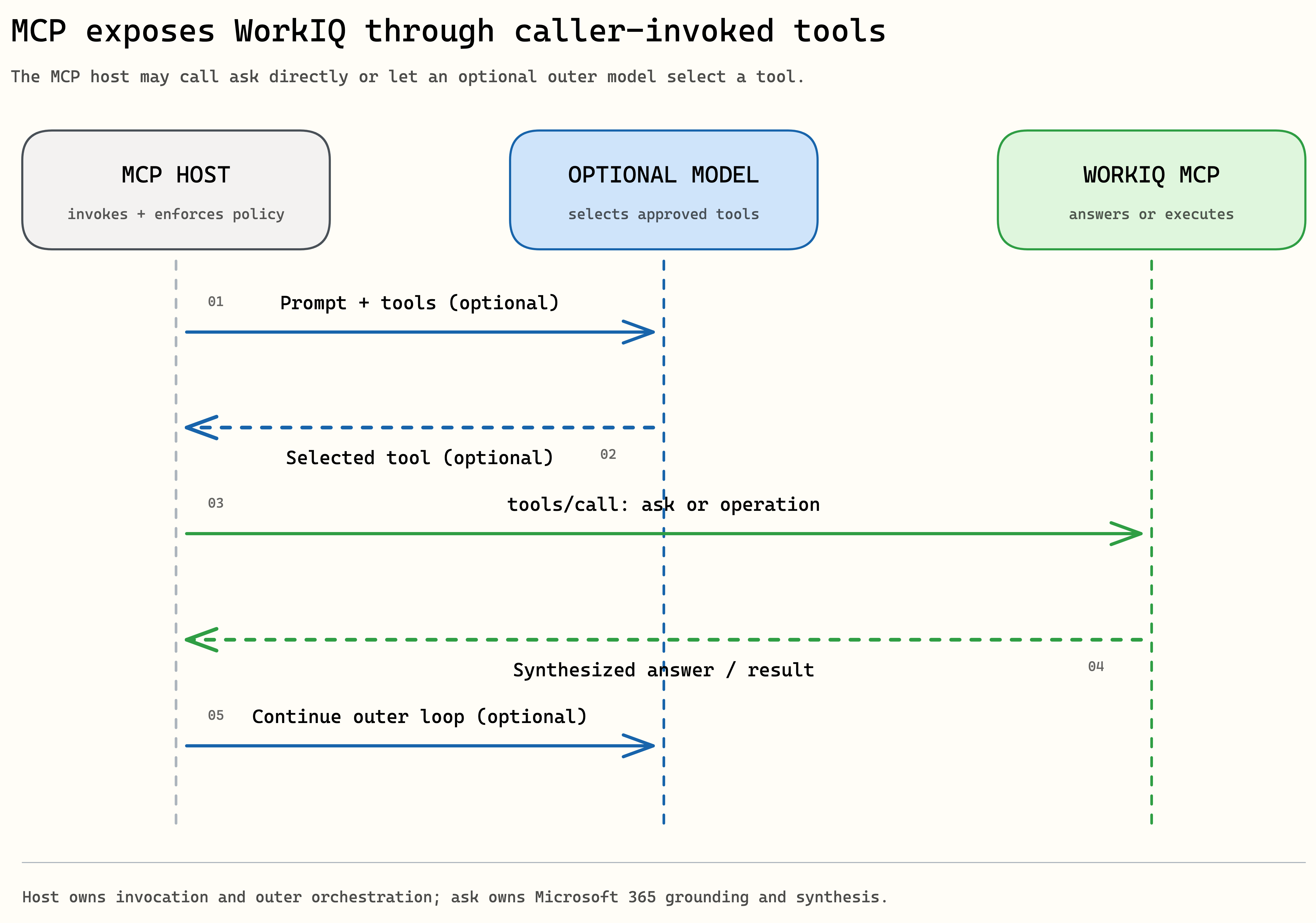
The MCP host owns policy, invocation, retries, and result handling. WorkIQ owns Microsoft 365
grounding and synthesis inside an ask call; an outer model is optional.
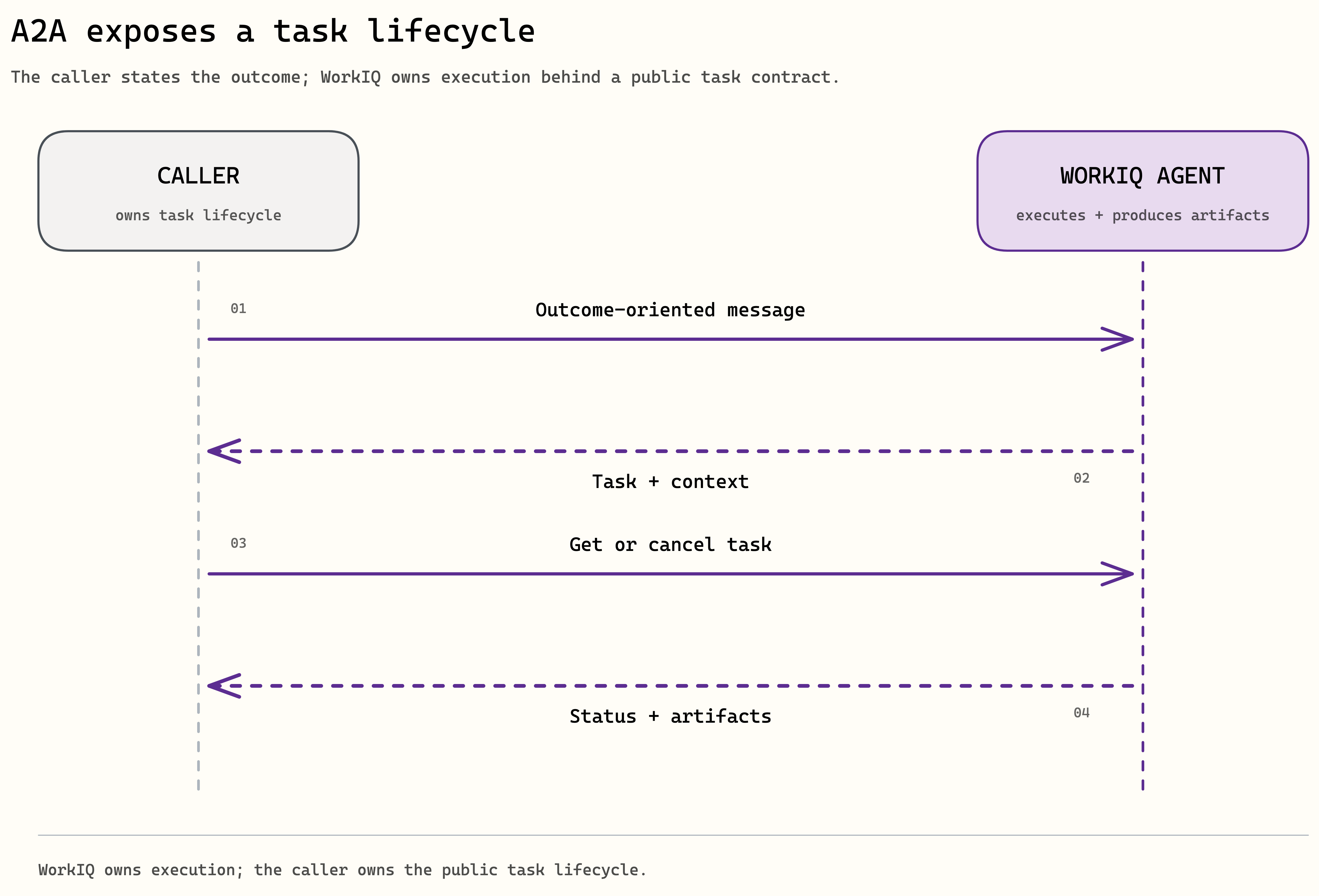
WorkIQ owns execution; the caller owns the public task lifecycle.
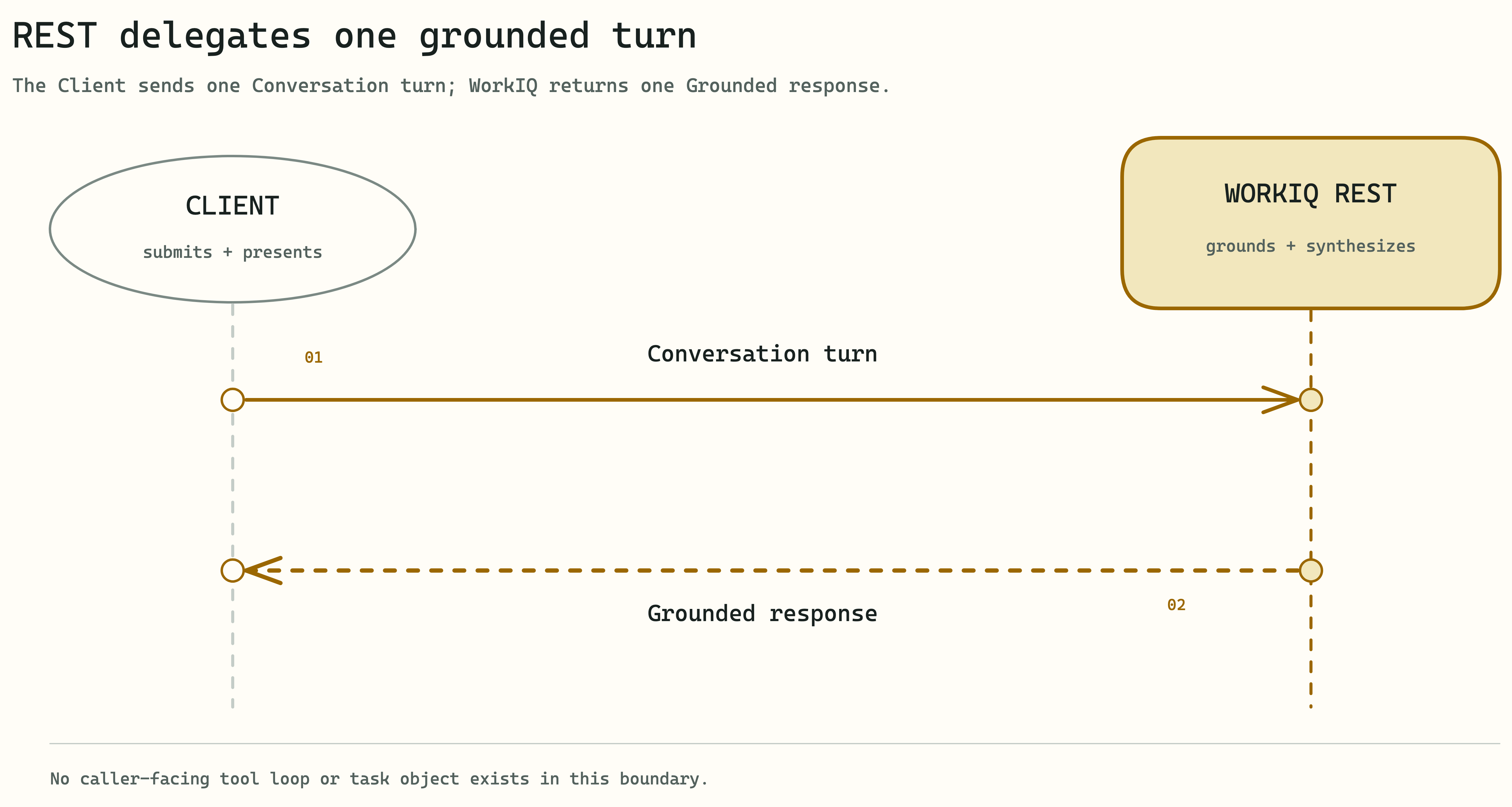
WorkIQ owns the turn. The client owns conversation persistence and presentation.
State invariants
| Identifier | Keep with |
|---|---|
| Outer-agent checkpoint | Application thread |
MCP ask conversationId |
Tenant + user + outer thread |
A2A contextId |
Tenant + user + workflow |
A2A task.id |
Tenant + user + delegated operation |
REST conversationId |
Tenant + user + chat |
These are application storage boundaries, not service retention guarantees. Transport sessions are not conversation state, and identifiers are not credentials. Use tenant ID, user identity, and the owning application thread, workflow, or chat as the storage key; never look up state by an identifier alone.
An outer-agent checkpoint is application-owned transcript and workflow state. A2A's task lifecycle
is the service-visible task.id, status, artifacts, cancellation, and subscription contract.
MCP has one additional trap: the host transcript and WorkIQ ask can each maintain context. Reusing
an inner conversationId can influence a response through state that is absent from the host
transcript, so scope it to the same tenant, user, and outer thread.