Handoff Pattern
The handoff pattern uses a triage agent to classify incoming requests and route them to specialist agents. Each specialist has focused expertise and tools.
Pattern Architecture
graph TD
    U[User Query] --> T[Triage Agent<br/>Classify & Route]
    T -->|billing| B[Billing Specialist<br/>Orders, refunds]
    T -->|technical| TE[Technical Specialist<br/>Product issues, FAQ]
    T -->|account| A[Account Specialist<br/>Access, settings]

    style T fill:#607D8B,color:white
    style B fill:#2196F3,color:white
    style TE fill:#FF9800,color:white
    style A fill:#4CAF50,color:white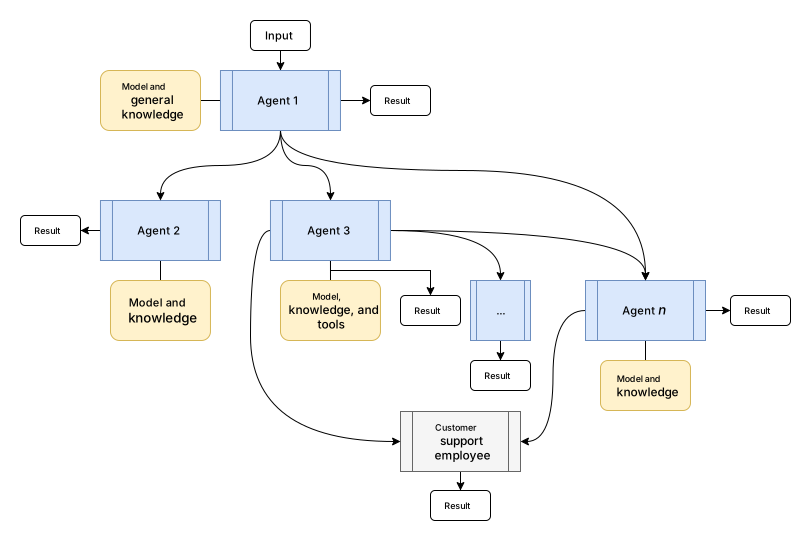
Source: MS Learn — AI Agent Design Patterns
When to Use
- Different input types require different expertise and tools
- You want to keep specialist agents focused with lean system prompts
- The routing logic can be expressed as classification
- Examples: customer support triage, document routing, task categorization
When to Avoid
- All queries need the same set of tools (use Single Agent)
- Tasks need multiple specialists to collaborate (use Brainstorm or Maker-Checker)
- The plan needs to adapt based on findings (use Magentic)
Context Passing Strategy
The handoff pattern uses a structured handoff object — a dataclass — to pass context from triage to specialist. The specialist does NOT see the triage agent's internal reasoning.
sequenceDiagram
    participant U as User
    participant T as Triage Agent
    participant S as Specialist

    U->>T: "I was charged twice for order ORD-1001"
    T->>T: Classify (structured output)
    Note over T: Produces HandoffContext:<br/>category=billing<br/>priority=high<br/>extracted_info={order: ORD-1001}
    T->>S: HandoffContext (structured object)
    Note over T,S: Specialist gets ONLY the<br/>structured handoff — not<br/>triage agent's reasoning
    S->>S: Resolve with specialist tools
    S-->>U: Resolution
Three Context Passing Options
The exercise implements Option 2 (structured handoff) and includes comments showing the alternatives:
| Option | What Gets Passed | Pros | Cons |
|---|---|---|---|
| 1. Full history | Triage conversation + all messages | Simple | Noisy — specialist sees triage reasoning |
| 2. Structured handoff (used) | HandoffContext dataclass |
Clean, focused | Must explicitly extract relevant info |
| 3. Selective history | Filtered messages (user/assistant only) | Balance | May miss relevant context |
Why structured handoff?
- Specialists stay focused — they don't see triage "thinking"
- Explicit about what information is passed
- Easy to extend (add fields to the dataclass)
- Works across process boundaries (serializable)
What We're Building
graph TD
    Q1[Query: Double charge] --> T[Triage Agent]
    Q2[Query: Can't log in] --> T
    Q3[Query: Bluetooth issue] --> T

    T -->|HandoffContext<br/>category=billing| B[Billing Specialist<br/>lookup_order, process_refund]
    T -->|HandoffContext<br/>category=account| A[Account Specialist<br/>search_faq]
    T -->|HandoffContext<br/>category=technical| TE[Technical Specialist<br/>search_faq]

    style T fill:#607D8B,color:white
    style B fill:#2196F3,color:white
    style A fill:#4CAF50,color:white
    style TE fill:#FF9800,color:white
Expected Console Output
══════════════════════════════════════════════════════════════════
  Handoff Pattern: Support Triage
══════════════════════════════════════════════════════════════════

══════════════════════════════════════════════════════════════════
  Customer Query 1/3
══════════════════════════════════════════════════════════════════
[INFO] Customer: I was charged twice for order ORD-1001...

══════════════════════════════════════════════════════════════════
  Triage
══════════════════════════════════════════════════════════════════
[INFO] [Triage Agent] Category: billing | Priority: high
[INFO] [Triage Agent] Reasoning: Customer reports duplicate charge...

[INFO] Handoff: Triage Agent → Billing Specialist (category=billing)
[INFO] Context: structured HandoffContext (query + category + priority + extracted_info)

[INFO] [Billing Specialist] I've looked up order ORD-1001 and
       can see the duplicate charge. Processing your refund now...
Ready to practice?
Continue with the hands-on exercise in the sidebar (✏️) to apply what you've learned.
Key Takeaways
- Handoff = classify → route → resolve with specialist agents
- Use structured outputs (Pydantic) for reliable triage classification
- Pass a structured handoff object — not raw conversation history
- Specialists get focused context — they don't see triage reasoning
- Each specialist has its own tools and system prompt
References
Hands-On Exercise
Head to the Handoff exercise — build a support triage system that classifies queries and routes to billing, technical, or account specialists.
You can run them from the terminal or use the Workshop TUI.