Concurrent Pattern
The concurrent pattern runs multiple agents in parallel on the same input, then combines their results. Think of it as getting multiple expert opinions simultaneously.
Pattern Architecture
graph TD
    I[Input: Stock Ticker] --> A1[Agent A<br/>Fundamental Analysis]
    I --> A2[Agent B<br/>Technical Analysis]
    I --> A3[Agent C<br/>Sentiment Analysis]
    A1 --> AGG[Aggregator Agent]
    A2 --> AGG
    A3 --> AGG
    AGG --> O[Output: Investment Report]

    style A1 fill:#2196F3,color:white
    style A2 fill:#FF9800,color:white
    style A3 fill:#9C27B0,color:white
    style AGG fill:#4CAF50,color:white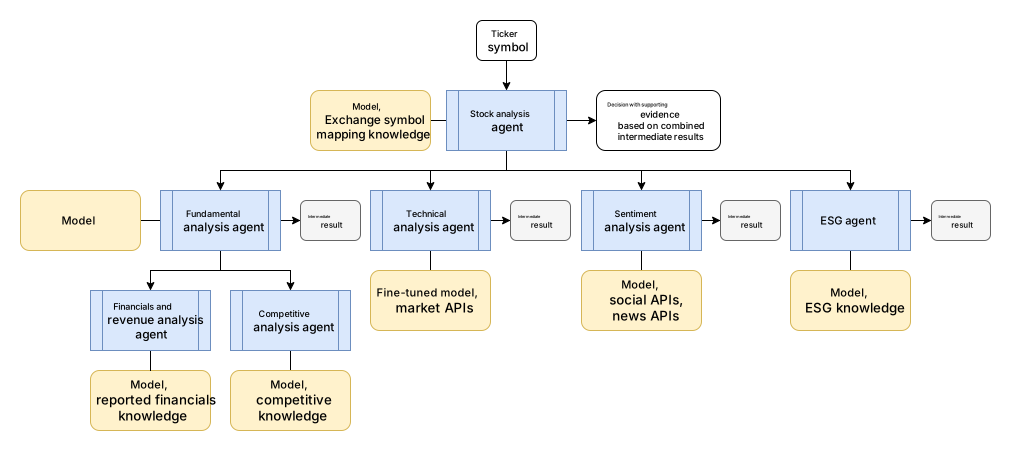
Source: MS Learn — AI Agent Design Patterns
When to Use
- Multiple independent analyses of the same data
- Each analysis benefits from a different perspective or expertise
- Analyses can run without depending on each other
- Examples: multi-perspective analysis, parallel data processing, ensemble reasoning
When to Avoid
- Agents need to see each other's output (use Brainstorm or Maker-Checker)
- One agent's output determines what other agents do (use Sequential or Handoff)
- The task is inherently serial
Context Passing Strategy
Each parallel agent gets the same initial input independently — no shared state between them. The aggregator gets all agent outputs as a combined input.
sequenceDiagram
    participant U as User
    participant F as Fundamental Agent
    participant T as Technical Agent
    participant S as Sentiment Agent
    participant A as Aggregator

    U->>F: "Analyze AAPL"
    U->>T: "Analyze AAPL"
    U->>S: "Analyze AAPL"
    Note over F,S: All three run in parallel<br/>with independent contexts.<br/>No shared state.
    F-->>A: Fundamental analysis
    T-->>A: Technical analysis
    S-->>A: Sentiment analysis
    Note over A: Aggregator sees ALL three<br/>outputs combined
    A-->>U: Synthesized investment report
Why independent contexts?
- Prevents one agent's reasoning from biasing another
- Each agent is free to form its own conclusions
- Enables true parallelism (no data dependencies)
- The aggregator can weigh conflicting opinions
How it works in Python: concurrent.futures.ThreadPoolExecutor runs each agent in its own thread. Each thread creates its own get_client() instance to avoid connection sharing issues.
What We're Building
graph TD
    T[Ticker: AAPL] --> F[Fundamental Analyst<br/>Revenue, earnings,<br/>market position]
    T --> TA[Technical Analyst<br/>Price trends,<br/>moving averages]
    T --> S[Sentiment Analyst<br/>News sentiment,<br/>social media buzz]
    F --> AGG[Aggregator<br/>Synthesize all<br/>perspectives]
    TA --> AGG
    S --> AGG
    AGG --> R[Investment Report<br/>with recommendation]

    style F fill:#2196F3,color:white
    style TA fill:#FF9800,color:white
    style S fill:#9C27B0,color:white
    style AGG fill:#4CAF50,color:white
Expected Console Output
══════════════════════════════════════════════════════════════════
  Concurrent Pattern: Stock Analysis
══════════════════════════════════════════════════════════════════
[INFO] Analyzing ticker: AAPL

══════════════════════════════════════════════════════════════════
  Fan-Out: Starting 3 parallel analysts
══════════════════════════════════════════════════════════════════
[INFO] [Fundamental Analyst] Starting analysis of AAPL...
[INFO] [Technical Analyst] Starting analysis of AAPL...
[INFO] [Sentiment Analyst] Starting analysis of AAPL...

[INFO] [Fundamental Analyst] Completed analysis
[INFO] [Technical Analyst] Completed analysis
[INFO] [Sentiment Analyst] Completed analysis

══════════════════════════════════════════════════════════════════
  Fan-In: Aggregating results
══════════════════════════════════════════════════════════════════
[INFO] [Aggregator] Synthesizing 3 analyst reports...
[INFO] [Aggregator] Investment Report: ...
Ready to practice?
Continue with the hands-on exercise in the sidebar (✏️) to apply what you've learned.
Key Takeaways
- Concurrent = fan-out/fan-in — same input, parallel processing, merged results
- Each agent works independently with no shared state
- The aggregator synthesizes potentially conflicting opinions
- Use
ThreadPoolExecutorfor real parallelism in Python - Each thread needs its own client instance (don't share connections)
References
Hands-On Exercise
Head to the Concurrent exercise — build a fan-out/fan-in stock analysis system with 3 parallel analysts and an aggregator.
You can run it from the terminal or use the Workshop TUI.